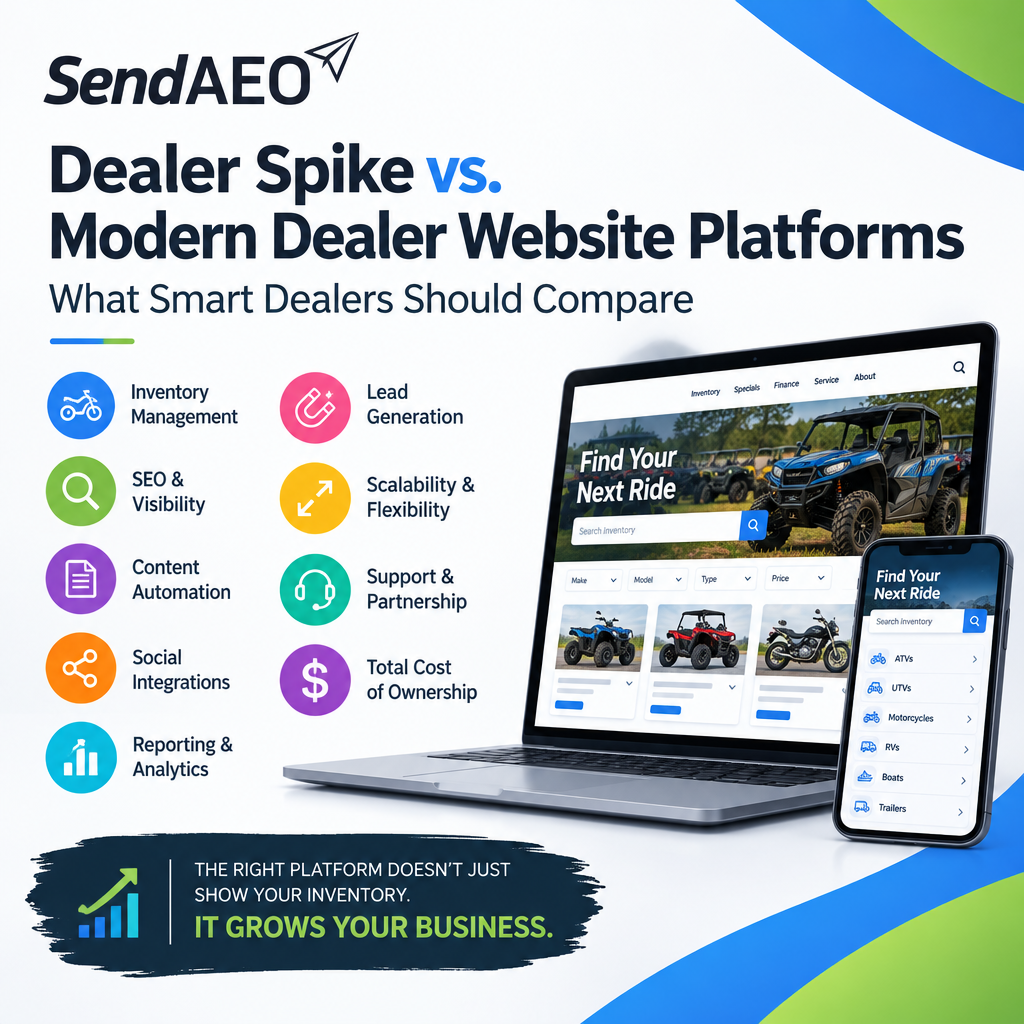
Dealer Spike vs Modern Dealer Website Platforms What Smart Dealers Should Compare
Dealer Spike vs. Modern Dealer Website Platforms: What Dealers Should Compare
TL;DR: When comparing Dealer Spike with newer dealership website platforms, the smartest approach is to look beyond templates and monthly fees. Dealers should compare how each platform handles inventory management, on-page SEO, content automation, social integrations, reporting, lead generation, flexibility, support, and long-term ownership costs. A strong platform should make inventory easier to market, support search visibility, connect cleanly with your sales process, and give your dealership more control over growth. The best solution is not always the most familiar one; it is the one that aligns with your goals, reduces friction, and creates measurable ROI over time.
Why This Comparison Matters
For many dealerships, the website platform is not just a digital brochure. It is the center of online merchandising, lead capture, search visibility, and customer engagement. That makes platform choice a strategic decision, not simply a design preference.
Dealer Spike is a recognized name in dealership websites, especially across powersports, equipment, RV, marine, and related verticals. At the same time, the market has evolved. Modern dealer website platforms now offer more flexible content tools, cleaner integrations, stronger analytics, and better control over SEO and digital performance. As a result, dealerships evaluating Dealer Spike against newer alternatives should focus on practical capability, not just brand familiarity.
A Fair Way to Compare Dealer Website Platforms
Any platform comparison should stay grounded in operational needs. Some dealers value speed and convenience. Others care more about customization, search performance, or lead attribution. The right platform depends on how your dealership sells, markets inventory, and measures success.
Instead of asking which platform is “best” in general, it is more useful to ask which platform is best for your dealership’s goals. A fair comparison between Dealer Spike and modern dealer website platforms should include the following categories:
- Inventory management and syndication
- SEO structure and on-page control
- Content automation and merchandising tools
- Social media integration and campaign support
- Reporting, analytics, and attribution
- Scalability and flexibility
- Support responsiveness and strategic guidance
- Total cost of ownership over time
Inventory Management: The Core of Dealership Website Performance
Inventory is usually the single most important content asset on a dealership website. Whether you sell motorcycles, ATVs, tractors, trailers, RVs, boats, or outdoor power equipment, your website needs to make that inventory easy to import, organize, optimize, and promote.
Dealer Spike has long been associated with inventory-driven dealer websites, and that remains one of the most important points in its favor. However, modern dealer website platforms often compete by offering more streamlined inventory workflows, cleaner admin experiences, and better flexibility around how inventory data is displayed and marketed.
What Dealers Should Look For in Inventory Management
- Feed quality and reliability: Can the platform import inventory accurately from your DMS, OEM source, or internal feed?
- Data normalization: Does it clean up inconsistent naming, trim packages, category labels, and specs?
- Bulk editing: Can your team make changes efficiently across many units at once?
- Merchandising flexibility: Can you control featured inventory, specials, promotions, and category placements?
- Unit detail page quality: Does each inventory page support strong content, media, SEO, and lead forms?
- Status controls: How easily can units be marked in stock, pending, sold, or on order?
- Syndication options: Can inventory be pushed to third-party marketplaces and ad channels as needed?
In practice, the difference between platforms often comes down to workflow efficiency. A dealer may have hundreds or thousands of units, and even small bottlenecks can create major time loss. Modern platforms that simplify inventory tagging, categorization, and merchandising can help your team move faster and reduce manual upkeep.
We help dealerships assess whether their current platform is truly supporting inventory visibility or simply hosting listings. In many cases, stronger inventory organization, better unit page content, and improved page indexing can lead to measurable gains in both traffic and lead volume.
SEO Capabilities: Visibility Depends on More Than Having Inventory Online
One of the biggest differences between legacy-style dealer website systems and modern platforms is SEO control. Many dealer websites technically have pages for units, locations, brands, and services. That alone does not guarantee visibility in search results.
Dealer Spike may provide a structured website environment, but modern dealer platforms often distinguish themselves by offering more robust control over metadata, internal linking, schema elements, indexation settings, content architecture, and page-level optimization.
What to Compare in Dealer SEO Functionality
- Editable title tags and meta descriptions: Can your team optimize high-value pages without support tickets?
- Clean URL structures: Are URLs readable, relevant, and consistent?
- Heading and content control: Can you manage H1s, page copy, FAQs, and supporting text easily?
- Inventory page indexing rules: Can the platform prevent duplicate or low-value pages from diluting search performance?
- Local SEO support: Does it support location pages, service area targeting, and structured local business information?
- Schema markup: Is important data clearly structured for search engines?
- Page speed and mobile usability: Is the site built to perform well for mobile shoppers?
- Internal linking opportunities: Can related inventory, finance pages, service pages, and brand pages reinforce one another?
SEO for dealerships is rarely solved by a platform alone, but the platform can absolutely help or hinder performance. If key pages are hard to optimize, if duplicate content is widespread, or if inventory pages lack meaningful text structure, rankings may plateau even when the dealership has strong products and market demand.
Our approach is to evaluate both technical SEO readiness and real on-page opportunity. That means identifying where your current website supports organic growth and where platform limitations may be holding back category pages, model pages, service pages, or local search visibility. We also build content frameworks that help dealerships rank for more than just unit names, including financing, service, seasonal demand, and buyer intent topics.
Content Automation: Helpful When It Supports Quality, Risky When It Replaces Strategy
Dealership websites often need to manage large amounts of repetitive data. For that reason, content automation has become a major selling point for website platforms. Automated population of specifications, manufacturer descriptions, pricing fields, special offers, and inventory status updates can absolutely save time.
But there is an important distinction between automation that improves efficiency and automation that creates thin, repetitive, or low-differentiation content. Dealer Spike and many other platforms may rely heavily on feed-based content. Modern dealer platforms increasingly try to combine automation with greater control over page-level messaging and SEO enhancement.
What Dealers Should Compare in Content Automation
- Automated inventory descriptions: Are they customizable, or are they mostly duplicated across many sites?
- Page generation tools: Can the platform create useful brand, category, location, and model hub pages at scale?
- Specials and promotion automation: Can sales or finance offers be updated quickly across relevant pages?
- Content governance: Can your team override automation easily when unique messaging is needed?
- Blog and resource support: Does the platform make it easy to publish educational content that supports SEO and conversion?
Good automation reduces repetitive manual work. Great automation still leaves room for original strategy. That matters because search engines and shoppers both respond better to pages that are useful, specific, and relevant to real purchase questions.
We help dealerships combine automation with original content planning. That includes optimizing high-value inventory categories, building location-specific landing pages, creating content around financing and trade-in topics, and ensuring automated page creation does not lead to duplicate or low-performing search assets.
Social Integrations: A Website Should Support the Full Marketing Ecosystem
Today’s dealership website does not operate in isolation. It should connect naturally with your social channels, paid campaigns, email marketing, and remarketing efforts. While social integrations may seem secondary compared with inventory and SEO, they can play an important role in amplifying promotions, inventory highlights, and seasonal campaigns.
Dealer Spike and other established platforms may offer varying levels of social connectivity, but modern website platforms often focus more heavily on flexible campaign support, embedded feeds, conversion tracking, and easier integration with lead forms and CRM workflows.
Key Social and Marketing Integration Features to Compare
- Social sharing on inventory pages: Can individual units or promotions be shared cleanly?
- Paid ad landing page flexibility: Can you build campaign-specific pages without developer delays?
- Lead form integrations: Do forms connect properly with your CRM or follow-up systems?
- Tracking implementation: Is it easy to deploy conversion events and campaign tracking?
- Dynamic content support: Can the site support inventory-focused social and paid ad campaigns effectively?
Social performance often depends on the quality of the destination experience. If your campaign sends shoppers to slow pages, cluttered layouts, or weak inventory details, marketing dollars become less efficient. A modern platform should support clean landing pages, strong mobile usability, and accurate source tracking.
We help dealerships align their websites with their broader digital marketing efforts so social traffic, paid traffic, and organic traffic all land on pages built to convert. That includes campaign page planning, tracking setup, conversion improvement, and creative alignment across channels.
Reporting and Analytics: You Need More Than Traffic Numbers
Reporting is one of the most overlooked platform comparison factors. Many dealership websites provide some form of dashboard data, but not all reporting is equally useful. A platform may show sessions, leads, and page views, yet still leave major visibility gaps around attribution, engagement quality, and inventory-level performance.
Modern dealer website platforms increasingly compete on data transparency. Dealers want to know which inventory categories are generating leads, which landing pages are driving calls, how organic traffic compares with paid traffic, and where bottlenecks exist in the conversion path.
What Good Reporting Should Help You Understand
- Lead source quality: Which channels are driving form fills, calls, and clicks?
- Inventory performance: Which units, brands, or categories generate the most interest?
- Page engagement: Where are users spending time, and where are they dropping off?
- SEO growth: Are rankings, impressions, and organic conversions improving over time?
- Campaign ROI: Which promotions and ad campaigns produce measurable outcomes?
- Location performance: If you have multiple rooftops, can you compare them clearly?
If your website platform limits access to raw data, event tracking, or third-party analytics flexibility, your dealership may be making decisions with incomplete information. That can impact ad spend, staffing, follow-up priorities, and content strategy.
We build reporting frameworks that go beyond platform-native dashboards. That means clearer lead attribution, better visibility into organic and paid performance, and custom reporting around inventory, forms, calls, and location-specific conversion activity. The goal is to make sure your website is not just producing data, but producing usable answers.
Design Flexibility and User Experience: Templates Are Only the Starting Point
Design matters, but not just for branding. Layout, navigation, inventory filters, mobile usability, and conversion placement all affect how easily a shopper can move from interest to inquiry.
Dealer Spike may offer dealership-specific design structures that work for many businesses. However, modern dealer website platforms often provide more flexibility for custom page layouts, stronger mobile-first experiences, and faster deployment of new campaign content.
When comparing platforms, dealerships should consider whether the site design supports real user behavior. Shoppers want to search inventory quickly, compare units, view financing options, and contact the store without friction. A visually acceptable site can still underperform if the user journey is confusing or conversion elements are weak.
We evaluate website UX through both conversion and SEO lenses. That includes navigation structure, search and filter behavior, form placement, mobile responsiveness, inventory page hierarchy, and opportunities to reduce abandonment.
Support and Strategic Partnership: Technology Alone Does Not Drive Growth
One of the most practical differences between providers is what happens after launch. Some dealerships want a mostly self-service platform. Others want strategic support that helps them improve performance over time. Neither preference is wrong, but it should influence platform choice.
Dealer website platforms vary significantly in support style, ticket responsiveness, account management depth, and strategic guidance. Some are stronger on software delivery than ongoing optimization. Others offer more collaborative support but may come with different pricing structures.
Dealers should ask direct questions about:
- Average support response times
- Whether SEO changes require a ticket
- How fast inventory issues are resolved
- Whether content updates are self-service or managed
- What level of strategic marketing input is included
- How reporting reviews and performance recommendations are handled
We support dealerships as both a performance partner and a practical problem-solver. That means helping with platform selection, migration planning, SEO improvement, content strategy, inventory merchandising, campaign landing pages, analytics configuration, and long-term optimization. The objective is not simply to get a site live, but to help it produce better business outcomes month after month.
Total Cost of Ownership: Monthly Fees Do Not Tell the Whole Story
Ownership costs are often discussed too narrowly. A platform’s quoted monthly rate matters, but it is only one part of the overall investment. Dealers should compare total cost of ownership across the full website lifecycle.
What to Include in Ownership Cost Comparisons
- Setup and migration fees
- Ongoing platform or hosting fees
- Charges for content edits or design changes
- SEO add-on costs
- Analytics and reporting limitations
- Third-party integration costs
- Training time for staff
- Opportunity cost from limited flexibility or weak performance
A lower monthly platform fee may not be the better value if it limits growth, slows your team down, or requires expensive workarounds. Likewise, a higher-priced platform may still be worthwhile if it improves lead volume, organic visibility, staff efficiency, and long-term conversion rates.
This is why we guide dealerships through a broader cost-benefit evaluation. We look at platform constraints, support needs, traffic potential, operational efficiency, content control, and realistic ROI, so the website decision reflects business impact, not just line-item pricing.
Questions Dealers Should Ask Before Choosing Between Dealer Spike and a Modern Platform
If your dealership is comparing Dealer Spike with another website provider, these questions can help create a more objective evaluation:
- How easily can our team manage and merchandise inventory without outside help?
- How much control do we have over SEO-critical page elements?
- Will the platform support unique content, not just feed-based content?
- Can we build landing pages and promotions quickly for campaigns?
- How well does it integrate with our CRM, forms, analytics, and ad tracking?
- What reporting do we receive, and is it actionable?
- What happens when we need support urgently?
- What costs should we expect over 12 to 36 months?
- Does the platform make us more agile as a dealership?
- Will this system help us compete more effectively in organic search and paid campaigns?
How We Help Dealers Make the Right Website Platform Decision
Choosing between Dealer Spike and a modern dealer website platform is not just about selecting software. It is about choosing the digital foundation that will support inventory visibility, lead generation, search growth, and marketing efficiency.
We help dealerships evaluate website platforms based on real business needs, not sales language. Our process includes:
- Platform comparison consulting: We assess strengths, tradeoffs, and fit based on your dealership’s goals.
- Website audits: We review current SEO, UX, inventory structure, page performance, and conversion issues.
- Migration planning: We help reduce SEO loss, preserve valuable URLs, and create a smooth transition path.
- Inventory optimization: We improve unit page quality, category structure, and merchandising strategy.
- SEO strategy and implementation: We build content frameworks, optimize key pages, and strengthen local visibility.
- Content support: We develop location pages, service pages, finance pages, buyer resources, and promotional content.
- Tracking and reporting setup: We configure analytics and conversion reporting so decisions are based on clear data.
- Ongoing performance support: We continue improving the website after launch through testing, reporting, and strategic updates.
Whether your dealership stays with an established provider or moves to a newer platform, the goal should be the same: build a website that performs better, gives your team more control, and supports sustainable growth.
Final Thoughts
Dealer Spike remains a known player in the dealership website space, and for some businesses it may still be a reasonable fit. But modern dealer website platforms have raised expectations across inventory handling, SEO control, content flexibility, reporting, and integration. That means dealerships should compare current capabilities carefully rather than relying on familiarity alone.
The best website platform is the one that helps your dealership merchandise inventory effectively, rank competitively, convert traffic efficiently, and adapt quickly as your marketing evolves. A fair comparison should account for software, support, strategy, and long-term business value.
If your dealership is evaluating website options, we can help you compare platforms clearly, identify hidden limitations, and build a digital strategy that turns your website into a stronger sales and marketing asset.
Frequently Asked Questions
Is Dealer Spike a bad platform for dealerships?
No. Dealer Spike is an established dealership website provider with experience in inventory-focused industries. The key question is not whether it is “bad,” but whether its features, flexibility, support model, and long-term fit align with your dealership’s goals compared with newer alternatives.
What is the biggest difference between Dealer Spike and modern dealer website platforms?
In many cases, the biggest differences are flexibility, ease of optimization, reporting transparency, and how well the platform supports modern SEO and digital marketing workflows. Some newer platforms provide more agile editing, better integrations, and stronger control over search-focused content.
Why does SEO matter so much when choosing a dealership website platform?
SEO affects how easily shoppers can find your inventory, service pages, finance content, and location information through search engines. A platform that limits SEO control can make it harder to grow organic traffic and compete in your market, even if the site looks fine visually.
Can a dealership website platform improve lead volume on its own?
A better platform can improve the conditions for lead generation by offering stronger inventory pages, faster load times, cleaner forms, and better user experience. However, results usually depend on a combination of platform quality, SEO strategy, paid traffic, content, and follow-up processes.
What should dealers look for in inventory management features?
Dealers should look for accurate feed handling, strong filters, easy bulk editing, status controls, merchandising options, customizable unit detail pages, and reliable integration with their internal systems. Inventory management should reduce manual work while improving shopper experience.
Are automated content tools good for dealership websites?
They can be very useful when they save time without creating thin or repetitive pages. The best platforms combine automation with enough manual control to let your dealership publish unique, high-value content where it matters most.
How do ownership costs differ between dealer website platforms?
Costs vary based on setup fees, monthly platform charges, support levels, content update policies, SEO add-ons, integrations, and reporting access. Dealers should compare total cost of ownership over time rather than focusing only on the initial monthly price.
Should a dealership switch platforms if the current website looks outdated?
Not always. An outdated design may justify a redesign, but the bigger question is whether the current platform is limiting performance, SEO, content control, reporting, or operational efficiency. Sometimes a redesign is enough. In other cases, a full platform change is the better long-term move.
How can we tell if our website platform is holding us back?
Warning signs include poor organic growth, limited page editing control, slow support for critical updates, weak reporting, duplicate content issues, clunky inventory workflows, and difficulty launching campaigns or new landing pages. A structured website audit can clarify where the limitations are.
Can you help us compare Dealer Spike to another dealer website platform?
Yes. We help dealerships review platform capabilities, identify tradeoffs, evaluate SEO and inventory implications, estimate total ownership costs, and choose a website solution that better supports growth, visibility, and lead generation.