Own More of Google First Page With Search Engine Real Estate
TL;DR
Search engine real estate is the practice of earning multiple high-visibility placements on Google’s first page instead of relying on a single website ranking. When a business appears through its website, Google Business Profile, local map pack, review platforms, directory listings, images, videos, social profiles, and relevant marketplaces, it increases trust, click opportunities, and lead volume while reducing dependence on any one listing. The most effective approach combines technical SEO, local SEO, content optimization, reputation management, media optimization, and off-site listing strategy so that more branded and non-branded searches lead potential customers into the business from several directions at once.
Search Engine Real Estate: How Businesses Can Capture More of Google’s First Page
Ranking well in Google is valuable. Owning more of the page is even better.
Many businesses approach SEO with a narrow goal: get the company website into one strong organic position and call it a win. While that can absolutely drive results, it also leaves opportunity on the table. Today’s search results are more dynamic than ever. A first page can include a company website, map listings, images, videos, FAQs, review sites, local directories, product feeds, marketplace listings, and branded social profiles. Businesses that understand this can turn one search into several chances to win the click.
This broader strategy is often referred to as search engine real estate. Instead of competing for just one blue link, the goal is to build a presence across as many relevant first-page features as possible. Done correctly, it strengthens credibility, improves click-through rates, increases lead generation, and gives prospects multiple trusted paths to conversion.
What Is Search Engine Real Estate?
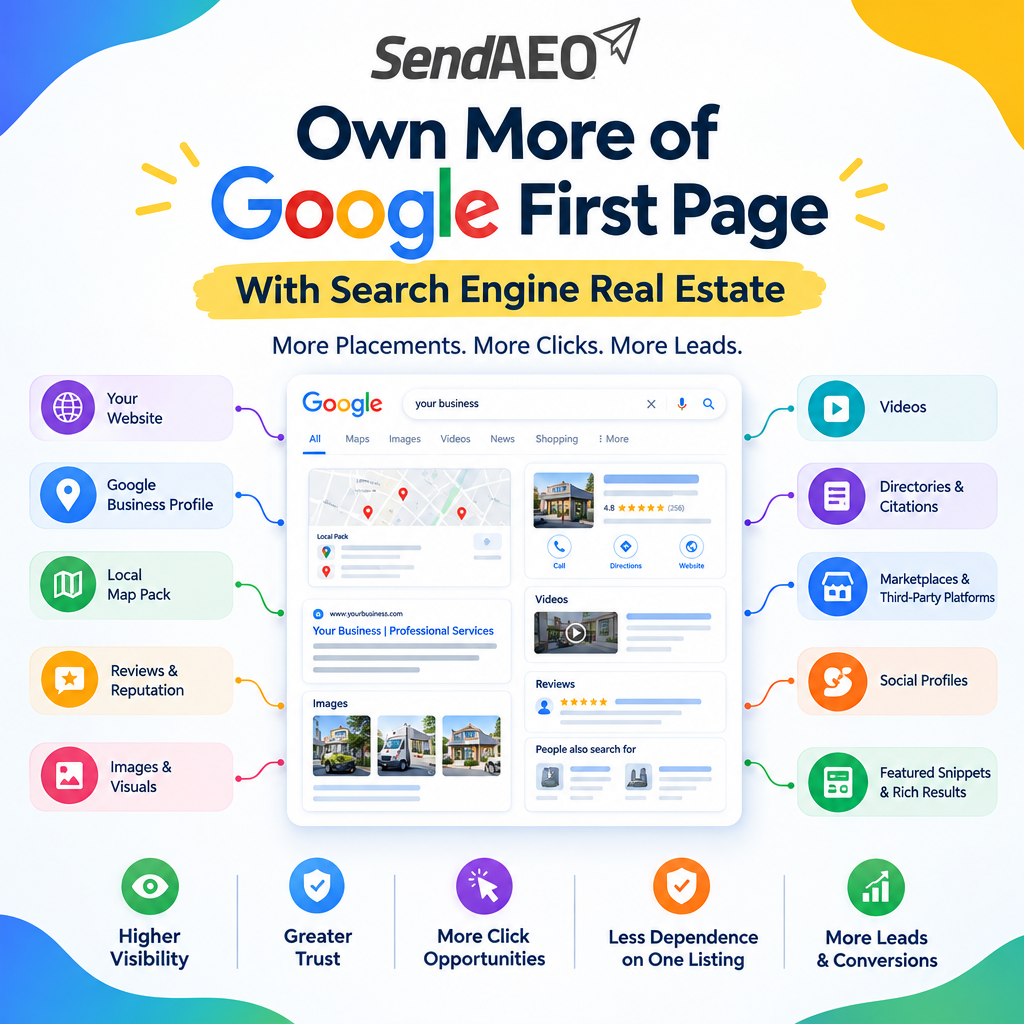
Search engine real estate refers to the total amount of visibility a business controls on a search engine results page. It includes traditional organic rankings, but it also extends to other assets tied to the business. Depending on the search query, this may include:
- Your main website pages
- Your Google Business Profile
- Google’s local map pack
- Industry-specific directory listings
- Review platforms
- Image results
- Video results
- Marketplace or reseller listings
- Branded social profiles
- Featured snippets, FAQs, and rich results
When several of these appear for the same search, your business takes up more screen space, looks more established, and gives users more reasons to choose you over competitors.
Why One Ranking Is Good, but Multiple Listings Are Better
A single organic ranking can produce great results, but it has limitations. Searchers do not all interact with the same result type. Some click websites. Others engage with map listings. Some trust review sites first. Some prefer videos or image results. If your business only appears once, you are relying on one specific user behavior. If you appear in multiple formats, you can meet users where they already prefer to click.
There are several strategic advantages to a multi-listing search presence:
Higher Visibility
More placements mean more visual dominance on the page. Even when users do not click immediately, repeated brand exposure increases recall and confidence.
Improved Trust
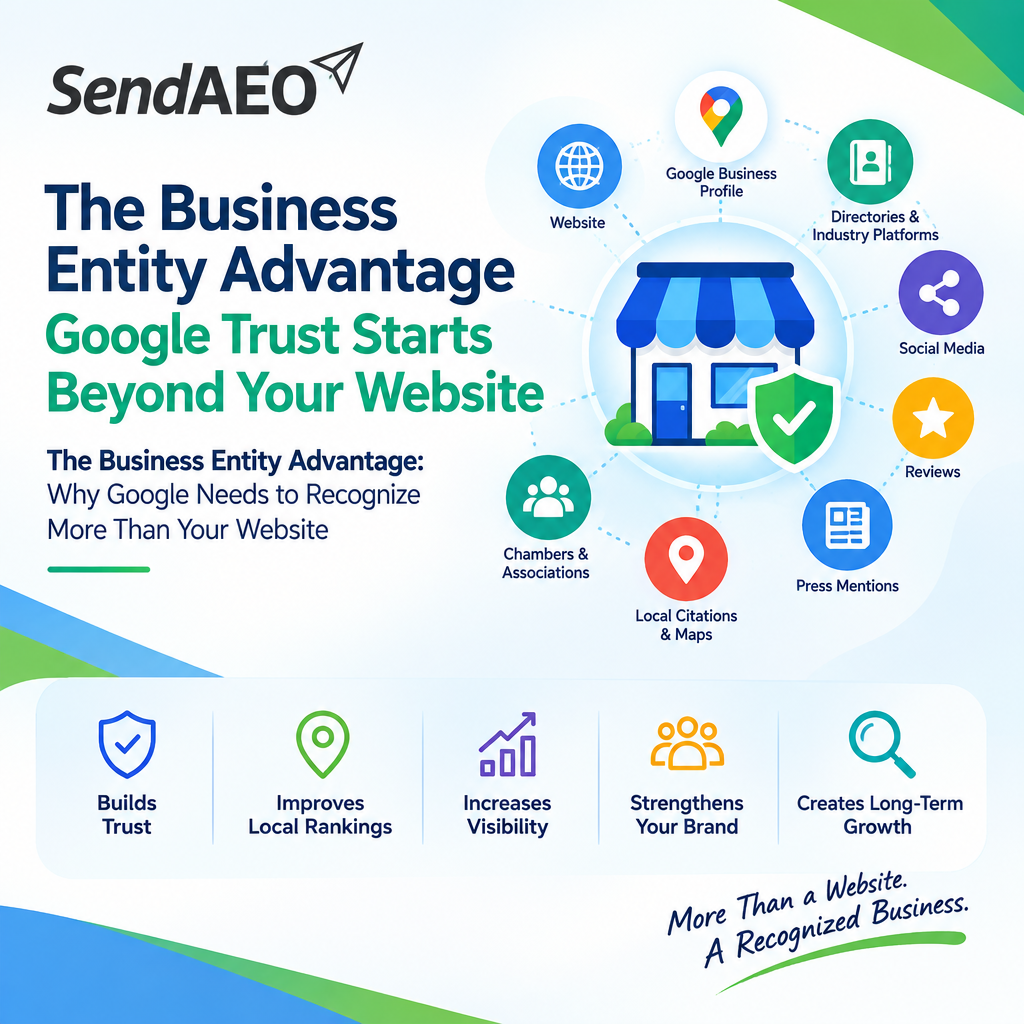
When your business appears on your website, in Google Maps, in review platforms, and in directory listings, it sends a consistency signal that reassures prospects.
More Click Opportunities
Different search features attract different kinds of users. A diversified first-page presence allows multiple paths into your sales funnel.
Less Dependence on One Asset
If one ranking drops temporarily, other listings can continue to drive leads. This creates a more durable search strategy.
In practical terms, this means a business can sometimes generate stronger results by controlling several positions across the page than by moving one webpage from position four to position two.
What Google’s First Page Looks Like Today
Modern search results are not limited to ten plain organic listings. Google presents results in different formats based on intent, location, device, and topic. For local and commercial searches, the first page may contain a map pack, sponsored placements, standard organic listings, image thumbnails, review snippets, product results, FAQ expansions, and video carousels.
That means businesses should think less in terms of “my ranking” and more in terms of “my total search footprint.” A search footprint includes every place your brand can realistically appear for a target query.
This is especially important on mobile, where a single search feature can dominate most of the visible screen. Capturing multiple placements increases the odds that your business is seen before users scroll far enough to evaluate alternatives.
The Core Assets That Build Search Engine Real Estate
To expand first-page visibility, businesses need to develop and optimize several search-facing assets at once. Each one contributes differently depending on the search type.
1. Your Company Website
Your website remains the central asset in any SEO strategy. It is where your brand messaging, conversion paths, service pages, location pages, and supporting content live. Strong website SEO helps you rank for high-intent keywords and gives Google the content it needs to understand your relevance.
To support broader search engine real estate, your website should include:
- Optimized service pages targeting core commercial terms
- Location pages for cities or service areas where appropriate
- Clear internal linking between related topics
- Strong page titles and meta descriptions
- Fast load times and mobile usability
- Structured data where relevant
- Helpful content that aligns with search intent
A well-optimized website gives you the foundation to support every other search channel.
2. Google Business Profile
For local businesses, Google Business Profile is one of the most powerful first-page assets available. It can appear in branded searches, map results, and local intent searches, often with calls, directions, reviews, photos, hours, services, and posts visible directly in the search result.
An optimized profile can dramatically improve local search presence through:
- Accurate primary and secondary categories
- Fully completed services and business details
- Consistent business name, address, and phone data
- Regular photo uploads
- Review generation and review response management
- Ongoing updates and content posts
A strong Google Business Profile does not just support local rankings. It often captures users who are ready to call or visit immediately.
3. Industry Directories and Citation Listings
Many searches trigger directory results because Google recognizes that users want comparison, validation, or local options. Relevant directory placements can put your business on the first page even if your website is not occupying every top organic position.
Examples include:
- Industry-specific associations and platforms
- Local business directories
- Review and reputation websites
- Niche marketplaces related to your services or products
The key is not listing your business everywhere indiscriminately. It is prioritizing the platforms Google already rewards for your target search terms and making sure your profiles are complete, accurate, and competitive.
4. Image Search Visibility
Images can appear within standard search results and dedicated image tabs. For many industries, especially home services, healthcare, retail, travel, hospitality, beauty, food, and design, visual results can attract meaningful traffic.
Businesses can improve image visibility by optimizing:
- Original photo quality and relevance
- Image filenames
- Alt text
- Surrounding page content
- Image compression and technical performance
- Geotagged and location-relevant media where appropriate
Images also strengthen your Google Business Profile and can reinforce user trust before a click ever happens.
5. Video Results
Video results frequently appear for educational, product-focused, how-to, and comparison searches. Businesses that publish optimized videos can gain first-page visibility beyond what website rankings alone can achieve.
High-value business video topics include:
- Service explanations
- Frequently asked questions
- Before-and-after showcases
- Product demonstrations
- Case studies
- Team introductions and process walk-throughs
When videos are properly titled, described, transcribed, and embedded into relevant website pages, they can support both video search visibility and traditional SEO performance.
6. Marketplaces and Third-Party Platforms
In some industries, Google strongly favors marketplace results for transactional searches. This is common in ecommerce, travel, food ordering, booking platforms, home service lead platforms, and software comparison queries. While your own website should remain central, strategic marketplace participation can give your business another first-page entry point.
The right approach depends on margins, lead quality, customer ownership, and platform fees, but ignoring marketplace visibility altogether can leave major demand uncaptured.
The Difference Between Ranking and Owning the Page
There is a major difference between appearing once on page one and appearing three, four, or five times in different forms.
| Single Ranking Approach | Search Engine Real Estate Approach |
|---|---|
| Focuses mainly on one website page | Optimizes website, maps, directories, media, and external listings together |
| Relies heavily on one click path | Creates multiple click paths for different user behaviors |
| More vulnerable to ranking fluctuations | More resilient because visibility is diversified |
| Can limit branded authority perception | Reinforces trust through repeated brand appearances |
| May miss opportunities in maps, video, and review platforms | Captures visibility across several result types |
This is why businesses that want stronger lead generation from search should think beyond rankings alone and start evaluating total search presence.
How Search Engine Real Estate Increases Leads and Conversions
More visibility is not just about vanity. It directly impacts lead generation and conversion performance.
When potential customers repeatedly see the same business across different trusted sources, several things happen:
- Brand familiarity grows. Repetition reduces uncertainty and makes your business feel more established.
- Validation becomes easier. Users can compare your website messaging against reviews, photos, directory listings, and other independent-looking sources.
- Intent is captured at multiple stages. Some users want information, others want reviews, and others want directions or immediate contact details.
- Competitive space shrinks. Every search feature you occupy is one less opportunity for a competitor to earn attention.
This often leads to better click-through rates, stronger assisted conversions, and more branded search activity over time.
Common Gaps That Limit First-Page Visibility
Many businesses already have some of the raw assets needed to build search engine real estate, but they are not fully optimized or strategically aligned. Common issues include:
- Google Business Profile is incomplete or poorly categorized
- Directory listings are inconsistent or outdated
- Website has weak service or location page coverage
- No video or image optimization strategy
- Reviews exist, but there is no active review acquisition process
- Important third-party profiles are unclaimed or underdeveloped
- Brand SERPs include competitors, outdated mentions, or low-quality results
- No structured tracking for how different search features contribute to leads
Fixing these gaps can often produce meaningful gains even before major website ranking jumps occur.
A Practical Strategy for Capturing More of Google’s First Page
An effective search engine real estate strategy is not random. It starts with analysis, then prioritization, then systematic optimization across the assets most likely to appear for your target searches.
Step 1: Audit the Current Search Landscape
The first step is identifying what appears on page one right now for your most important keywords. This includes branded terms, service terms, local terms, and high-intent informational searches. The goal is to answer questions like:
- Which result types dominate page one?
- Where does your business already appear?
- Which competitors control multiple placements?
- Which directories, marketplaces, and content formats show repeatedly?
This analysis reveals the clearest opportunities to expand your footprint.
Step 2: Strengthen Core Website SEO
Your website should be built to support both direct rankings and authority signals for your wider presence. That means improving technical SEO, refining on-page targeting, expanding content depth, and aligning pages with actual search intent.
In many cases, we help businesses reorganize service architecture, improve location relevance, strengthen metadata, and create supporting content that earns more rich and relevant search appearances.
Step 3: Optimize Google Business Profile for Local Dominance
If local intent is part of the search journey, Google Business Profile should be treated as a primary acquisition channel, not an afterthought. We optimize categories, services, profile completeness, image quality, review velocity, and local relevance factors to improve map pack competitiveness and branded search presentation.
This often becomes one of the fastest ways to increase first-page visibility and direct lead activity.
Step 4: Build and Clean Up Third-Party Listings
Citation consistency and directory quality still matter, especially for local SEO and trust signals. We identify the directories and industry platforms most relevant to your market, correct inconsistent business data, improve profiles, and strengthen category targeting where possible.
The aim is not volume for the sake of volume. It is strategic placement in platforms that actually influence search visibility and customer trust.
Step 5: Expand Into Images and Video
Visual search visibility is often underused, yet it can be highly effective. We help businesses plan and optimize image libraries, before-and-after collections, service photography, explainer videos, FAQ videos, and location-specific media assets so they support both user engagement and search performance.
For many businesses, visual assets also improve website conversion rates after the click.
Step 6: Manage Reviews and Reputation Signals
Reviews influence both rankings and click behavior. A strong review strategy can improve Google Business Profile performance, strengthen third-party platform visibility, and enhance conversion across the entire search ecosystem.
We help businesses develop review acquisition processes, response workflows, and reputation improvement strategies that support both local SEO and buyer trust.
Step 7: Track Search Footprint, Not Just One Ranking
A real search engine real estate strategy should be measured across all meaningful search appearances. That includes organic website clicks, map interactions, branded result improvements, directory referral traffic, review platform visibility, and video or image search traction.
This wider measurement framework gives a more accurate picture of how search is contributing to awareness, leads, and revenue.
Where Screenshots and Before-and-After Examples Make This Strategy Clear
This topic is especially powerful when supported by real visual comparisons. In reporting and strategy reviews, before-and-after screenshots can help illustrate how a business expands its first-page footprint over time.
Useful examples often include:
- A branded search before and after optimization of website sitelinks, Google Business Profile, and directory consistency
- A local service search showing movement from one organic result to multiple appearances across the map pack, organic listings, and review platforms
- An image or video search comparison showing new visual assets entering page one results
- A competitor comparison showing how one brand controls more first-page real estate despite similar website authority
These examples make an important point: growth in search does not always look like one ranking rising. Often, it looks like the business appearing in more places users are already clicking.
Who Benefits Most From Search Engine Real Estate?
Almost any business can benefit, but the strategy is especially effective for:
- Local service businesses competing in map-heavy searches
- Multi-location businesses seeking broader local coverage
- Healthcare, legal, and professional service providers where trust signals matter heavily
- Home services and contractors with strong before-and-after visual content
- Retail and ecommerce brands balancing website and marketplace visibility
- Hospitality, food, travel, and beauty businesses with review-driven decision making
- B2B companies that benefit from educational content and branded authority control
If prospects tend to research before contacting you, then controlling more of what they see in search results can materially influence outcomes.
How We Help Businesses Capture More of Google’s First Page
Building search engine real estate requires coordination across SEO, local optimization, content, media, listings, and reputation management. That is where a structured strategy makes the difference.
We help businesses expand their first-page presence through a combination of services tailored to where the best opportunities exist. Depending on the market, this may include:
SEO Audits and Search Footprint Analysis
We identify where your business appears today, where competitors are outperforming you, and which result types offer the biggest upside.
Website SEO and On-Page Optimization
We improve technical health, content targeting, service pages, location pages, metadata, and internal linking to strengthen organic visibility.
Google Business Profile Optimization
We optimize local categories, services, descriptions, images, and review signals to improve map pack visibility and branded search performance.
Citation and Directory Management
We clean up inconsistent listings, build relevant citations, and strengthen your presence on platforms that matter in your industry.
Review and Reputation Strategy
We help create repeatable review generation and response processes that support visibility, credibility, and conversions.
Image and Video SEO
We optimize visual assets so they can contribute to search visibility while also strengthening on-site conversion performance.
Our goal is not simply to improve one ranking. It is to help businesses create a larger, stronger, and more resilient presence wherever prospects encounter them in search.
Why This Strategy Matters More in Competitive Markets
In highly competitive industries, everyone wants the same top organic spots. That competition can make pure ranking gains slower and more expensive. Search engine real estate offers another way to win.
By targeting multiple search features at once, businesses can grow total visibility without relying on a single breakthrough ranking. In many cases, this creates momentum: stronger brand signals, more user engagement, better reviews, more branded searches, and more supporting content all work together to improve broader search performance.
In other words, search engine real estate is not separate from SEO. It is a more complete way of doing SEO.
Final Thoughts
If your business is only aiming for one organic ranking, it may be underestimating how people actually search and choose providers today. Google’s first page is a competitive environment filled with multiple result types, and businesses that occupy more of those spaces consistently gain an edge.
The most effective strategy is to treat search visibility as an ecosystem. Your website, Google Business Profile, reviews, directories, media assets, and third-party platforms should work together, not separately. When they do, your business becomes easier to find, easier to trust, and easier to choose.
Capturing more of Google’s first page is not about gaming the results. It is about building a more complete digital presence that reflects authority, relevance, and credibility wherever prospects are looking.
Frequently Asked Questions
What does search engine real estate mean?
Search engine real estate refers to how much visibility your business controls on a search results page. This can include your website rankings, Google Business Profile, map listings, directory profiles, review sites, image results, video results, and other search features.
Why is it better to appear multiple times on Google’s first page?
Multiple appearances increase visibility, trust, and click opportunities. They also reduce your dependence on one ranking and make your brand look more established to searchers comparing options.
Is search engine real estate only for local businesses?
No. Local businesses benefit strongly through maps and Google Business Profile, but ecommerce brands, B2B companies, professional services, and national brands can also expand visibility through content, videos, images, directories, marketplaces, and branded search optimization.
What is the difference between SEO and search engine real estate?
Traditional SEO often focuses primarily on improving website rankings. Search engine real estate includes that, but it also focuses on growing your presence across all relevant first-page features and platforms tied to your brand.
How does Google Business Profile support first-page visibility?
Google Business Profile can appear in branded results, map pack listings, and local intent searches. It often includes reviews, photos, business hours, directions, and contact options, making it one of the most valuable local search assets.
Do directory listings still matter for SEO?
Yes, especially for local SEO and credibility. High-quality, relevant directories can support visibility, reinforce business information consistency, and provide additional first-page placements for important searches.
Can images and videos really help a business show up more in search?
Yes. Google often displays images and videos in search results, especially for visually oriented, educational, or commercial topics. Optimized visual content can create additional visibility and improve engagement.
How long does it take to improve search engine real estate?
Timelines vary by industry, competition, and current asset quality. Some improvements, like Google Business Profile optimization and citation cleanup, can produce results relatively quickly, while stronger organic and media visibility usually builds over a longer period.
How do you measure success with this strategy?
Success is measured by total first-page presence, organic traffic, map interactions, referral traffic from directories, branded search improvements, review growth, lead quality, and overall conversion performance rather than only one keyword ranking.
How can we get help capturing more of Google’s first page?
The best starting point is a search visibility audit that reviews your website, Google Business Profile, directory presence, reputation signals, media assets, and competitor footprint. From there, a targeted strategy can be built to expand your presence across the search features that matter most to your business.