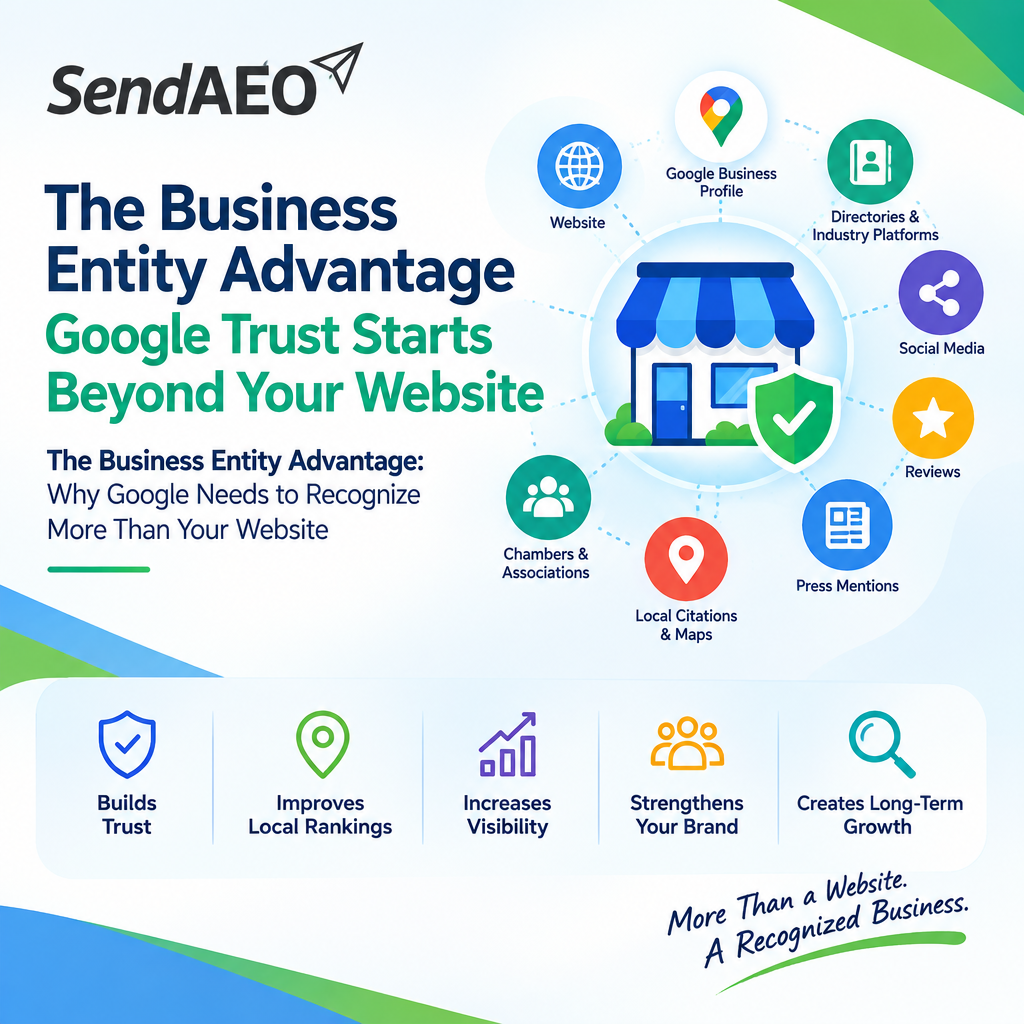
The Business Entity Advantage Google Trust Starts Beyond Your Website
The Business Entity Advantage: Why Google Needs to Recognize More Than Your Website
TL;DR: Strong search visibility is no longer built by website SEO alone. Google increasingly evaluates whether a business is a real, consistent, and independently verifiable entity across the web. That means your website should align with your Google Business Profile, industry directories, social profiles, local citations, reviews, press mentions, and other trusted third-party sources. When your business identity is complete and consistent everywhere it appears, Google has more confidence in who you are, what you do, where you operate, and whether you deserve to rank. The most effective strategy is not just getting links, but building a trustworthy business presence that search engines can confirm from multiple sources.
For many businesses, SEO has long been treated as a website-only effort. Improve title tags, publish service pages, write blog content, and build backlinks. Those steps still matter, but they are no longer enough on their own. Search engines have evolved. Google does not want to rank just a web page. It wants to understand the business behind that page.
That shift has major implications for visibility, trust, and long-term search performance. If your website says one thing, your Google Business Profile says another, your directory listings are inconsistent, and your social accounts look incomplete or abandoned, Google receives mixed signals. Even if your website content is well written, your broader digital identity may not support the level of trust needed to compete.
The businesses that gain an edge today are the ones that look real, established, and verifiable everywhere Google looks. This is the business entity advantage.
What a Business Entity Means in SEO
In practical terms, a business entity is the recognized identity of your company across the web. It goes beyond your domain name and includes the signals that confirm your organization exists as a legitimate business with a clear name, location, services, leadership, reputation, and footprint.
Google pieces this understanding together from many sources, including:
- Your website and its structured business information
- Your Google Business Profile
- Industry-specific platforms and directories
- Social media accounts
- Review platforms
- Maps and citation sites
- Local chamber, association, or partner listings
- Press mentions and editorial coverage
- Third-party references that mention your business without linking
When those signals align, Google can more confidently connect your brand name, contact information, location, expertise, and reputation. That confidence can support stronger local rankings, branded search visibility, trust in service-area relevance, and overall authority in your market.
Why Website-Only SEO Falls Short
It is common for businesses to invest heavily in on-site SEO while overlooking the broader ecosystem that validates their identity. A polished website is important, but it is ultimately a self-published asset. Google knows that any business can say anything about itself on its own site.
What carries more weight is confirmation. When your website claims are supported by consistent third-party signals, your business appears more credible. When they are unsupported or contradicted elsewhere, your website becomes harder for Google to trust at face value.
This is especially important in competitive industries, local markets, and service categories where trust matters. Businesses in legal, healthcare, home services, financial services, professional consulting, and location-based industries often need more than content and backlinks. They need strong entity validation.
The Difference Between Publishing Links and Building Real Trust
One of the biggest misconceptions in SEO is that visibility improves simply by acquiring more links. Links can help, but not all links are equal, and links without context rarely build lasting trust.
There is a major difference between:
- Publishing links: placing your website URL on random sites, low-quality directories, thin guest posts, or irrelevant listings
- Building a verifiable business presence: earning accurate, relevant mentions on trusted platforms that confirm your identity and reinforce your market presence
A business profile on a respected industry directory, a consistent listing on major local citation platforms, a complete Google Business Profile, active social accounts, and an editorial mention from a credible publication all contribute to a stronger entity footprint. These signals do more than point to your site. They help validate your business independently.
That is the distinction many businesses miss. SEO authority is not just about link volume. It is about whether your business can be recognized, corroborated, and trusted across multiple sources.
Why Consistency Matters Across Every Business Profile
Consistency is the foundation of entity recognition. If your business name, address, phone number, website, categories, service descriptions, operating hours, or brand presentation differ from platform to platform, Google may struggle to determine which version is correct.
Even small inconsistencies can dilute trust over time, such as:
- Using different versions of the business name
- Old addresses or outdated phone numbers still indexed online
- Mismatched business categories across listings
- Conflicting hours of operation
- Separate social handles with incomplete branding
- Duplicate directory listings
- Old websites or microsites still appearing in branded searches
Consistency does not mean every profile must use identical wording in every field. It means the core business identity must remain aligned so that search engines and customers receive the same message everywhere they look.
Key Places Google Looks for Business Validation
Google uses a broad set of signals to evaluate legitimacy and relevance. The most important sources typically include the following:
1. Your Website
Your site remains the central hub of your digital presence. It should clearly present your business name, services, geographic relevance, contact information, trust signals, about page details, and conversion paths. It should also reinforce expertise through useful content and transparent business information.
2. Google Business Profile
This is one of the strongest local trust signals available. A properly optimized profile with accurate categories, business description, service areas, photos, updates, reviews, and complete contact details can significantly strengthen entity clarity and local search performance.
3. Industry Platforms and Directories
Relevant directories help confirm your specialization and market category. For many businesses, these listings are more valuable than general low-quality directories because they add topical relevance and credibility.
4. Social Media Profiles
Social accounts may not function like traditional ranking factors, but they contribute to entity confirmation. Complete, active, and branded profiles help validate your business identity and increase confidence in your legitimacy.
5. Review Platforms
Customer reviews on trusted platforms do more than influence buyers. They also help reinforce the existence, reputation, and real-world activity of your business.
6. Local and Third-Party Mentions
Mentions from chambers of commerce, community organizations, local news, business associations, suppliers, partners, and sponsorships can create meaningful trust signals. These references often carry strong credibility because they are independently published.
How Incomplete Entity Signals Limit Growth
Many businesses are unknowingly held back by fragmented digital footprints. Their website may be modern and optimized, but their broader identity is weak, inconsistent, or missing from the platforms Google expects to see.
Common problems include:
- Unclaimed or incomplete business profiles
- Directory inconsistencies from old moves, rebrands, or phone changes
- A lack of trusted mentions beyond the company website
- Poor alignment between website messaging and Google Business Profile categories
- Little or no reputation development through reviews
- No coordinated strategy for local, brand, and industry validation
When these gaps exist, Google has fewer reliable signals to work with. That can affect visibility not just in map results, but also in organic search, branded queries, and category-specific searches where trust and relevance are critical.
What a Strong Entity-First SEO Strategy Looks Like
A stronger approach begins with the understanding that your website is one part of a larger trust ecosystem. The goal is to create a complete, accurate, and credible digital footprint that supports both search engines and potential customers.
This usually includes:
- Auditing all current business listings and mentions
- Standardizing core business information across platforms
- Optimizing Google Business Profile for completeness and relevance
- Cleaning up duplicate, outdated, or conflicting citations
- Expanding into quality industry and local directories
- Strengthening branded social profiles
- Improving website trust pages, contact details, and location signals
- Developing third-party mention opportunities through partnerships, PR, sponsorships, and local involvement
- Supporting review generation and reputation management
- Aligning all entity signals with your actual service areas and business goals
This kind of work is more strategic than basic citation submission or one-off link placement. It is about making your business easier for Google to understand and harder to dismiss.
How We Help Strengthen Your Business Entity Presence
Improving entity recognition requires more than checking a few profile boxes. It takes coordinated analysis, cleanup, optimization, and ongoing management. That is where a structured strategy makes a measurable difference.
We help businesses build stronger search trust by identifying where their digital identity is fragmented, incomplete, or underperforming. From there, we create a plan to reinforce the signals that matter most.
Our support can include:
- Entity and citation audits: reviewing where your business appears online and finding inconsistencies, duplicates, and missed opportunities
- Business information standardization: aligning your core details across website, listings, and profiles
- Google Business Profile optimization: improving categories, descriptions, services, media, updates, and local relevance
- Directory and industry listing management: prioritizing quality platforms that reinforce trust and visibility
- On-site trust signal improvements: enhancing your contact pages, location pages, about content, schema-related business details, and credibility elements
- Reputation strategy support: helping create a more consistent review and response process
- Third-party mention development: identifying credible opportunities to expand your independent web presence
- Ongoing monitoring: keeping your entity signals clean, accurate, and aligned as your business evolves
The result is a stronger foundation for SEO that supports rankings, local visibility, and buyer confidence at the same time.
Why This Matters Even More in Competitive Markets
When multiple businesses offer similar services and target the same keywords, small trust advantages can create meaningful ranking differences. In these situations, Google often looks beyond page optimization alone. It wants additional confirmation that a business is established, relevant, and deserving of visibility.
That is why entity strength is often a competitive separator. A business with clean citations, strong review signals, accurate profiles, local mentions, and aligned branding across the web can appear more dependable than a competitor with a better-looking site but weaker validation.
This is not about gaming search engines. It is about reducing ambiguity. The easier it is for Google to verify your business from multiple trusted sources, the more stable your visibility can become over time.
Entity Building Supports More Than Rankings
One of the biggest benefits of this strategy is that it improves more than SEO. A well-managed business identity helps with:
- Higher confidence during the customer research process
- Stronger brand consistency
- Better local discovery across search and map platforms
- Cleaner customer contact experiences
- Improved lead quality from accurate listings and positioning
- Greater resilience after business moves, rebrands, or service changes
In other words, business entity optimization is not just a technical SEO task. It is part of your broader digital credibility.
The Bottom Line
Google wants more than a website to trust. It wants evidence that your business exists, operates consistently, and is recognized by other credible sources online. That means your SEO strategy should extend beyond your pages and into the full network of profiles, platforms, mentions, and signals that define your business identity.
If your online presence is fragmented, outdated, or thin outside your website, you may be limiting your visibility without realizing it. But when your business is clearly and consistently validated across the web, Google has a much stronger basis for understanding and trusting who you are.
A stronger entity presence can support better rankings, better local performance, and better trust from the people searching for your services. That is why modern SEO is no longer just about optimizing a site. It is about establishing a business presence that search engines can independently verify.
Frequently Asked Questions
What is a business entity in SEO?
A business entity in SEO refers to the identifiable, verifiable presence of a company across the web. It includes your website, Google Business Profile, directories, reviews, social profiles, and third-party mentions that help search engines confirm your legitimacy and relevance.
Why is Google not satisfied with just my website?
Your website is self-published, so Google looks for outside confirmation. Independent sources help validate that your business is real, active, consistent, and trusted. The more those signals align, the easier it is for Google to understand and trust your brand.
Are backlinks still important?
Yes, backlinks still matter, but quality and context matter far more than quantity. Links that come from relevant, credible sources and support your broader business identity are more valuable than random low-quality placements.
What is the difference between citations and entity building?
Citations are one part of entity building. They usually refer to listings that include your business name, address, phone number, and other details. Entity building is broader and includes citations, reviews, social profiles, website trust signals, Google Business Profile optimization, and independent third-party mentions.
Can inconsistent business information hurt SEO?
Yes. Inconsistent information can create confusion for search engines and customers. Conflicting names, addresses, phone numbers, or categories may reduce trust in your business data and weaken local and organic visibility.
Does this only matter for local businesses?
No. It is especially important for local businesses, but any company can benefit from stronger entity recognition. Businesses that operate regionally, nationally, or in specialized industries also need a trustworthy and consistent digital footprint.
How long does it take to improve business entity signals?
It depends on your current footprint, the number of inconsistencies that need correction, and the competitiveness of your market. Some improvements can be made quickly, while broader trust and visibility gains often build over time as Google recrawls and reconciles information across the web.
What should be fixed first?
Usually the first priorities are your website’s core business details, your Google Business Profile, major citation sources, duplicate listing cleanup, and any outdated or conflicting contact information. From there, stronger directory, review, and third-party mention strategies can be layered in.
Can you help manage this process?
Yes. A structured entity strategy typically includes auditing your current presence, correcting inconsistencies, optimizing key profiles, improving on-site trust signals, and building more reliable third-party validation. Ongoing monitoring helps keep everything aligned as your business grows.