Connect Your Marketing Systems to Boost Growth Speed and Results
Connect Your Marketing Systems for Better Growth, Visibility, and Results
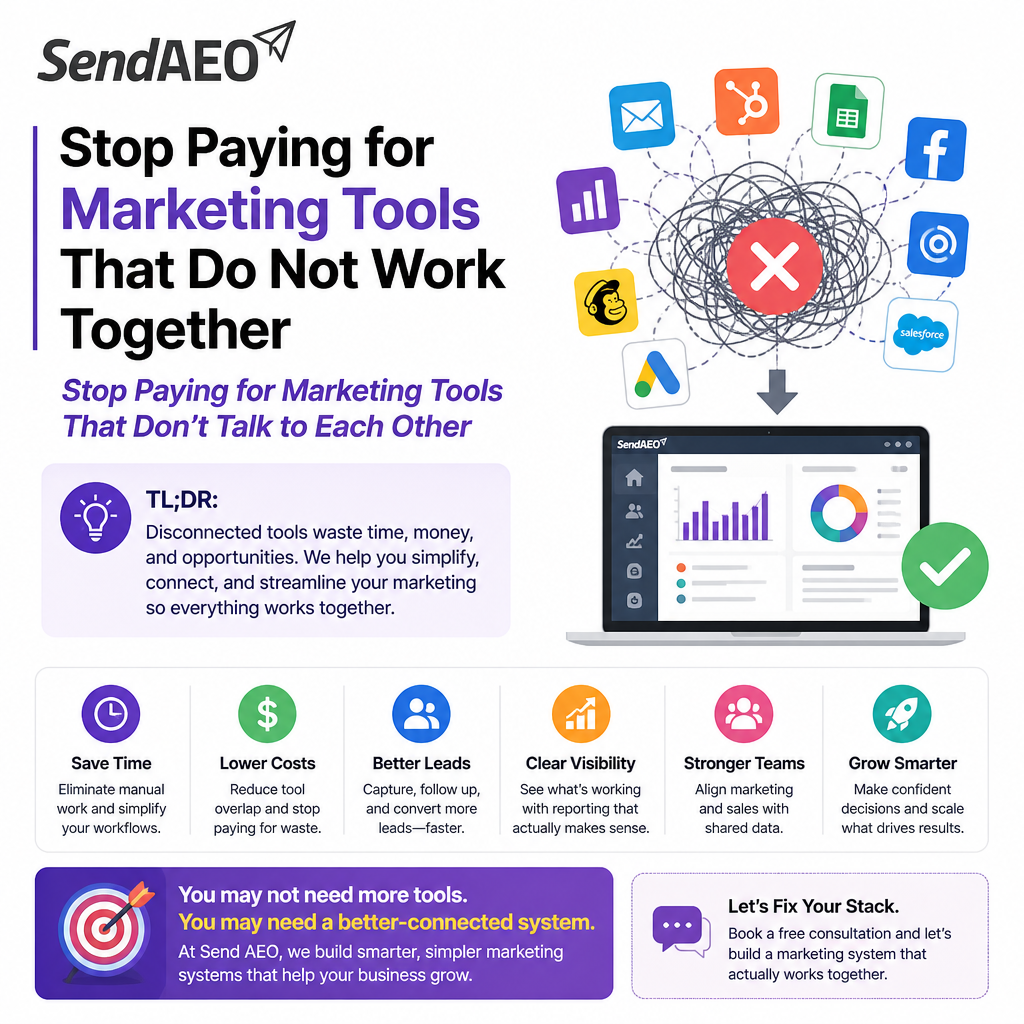
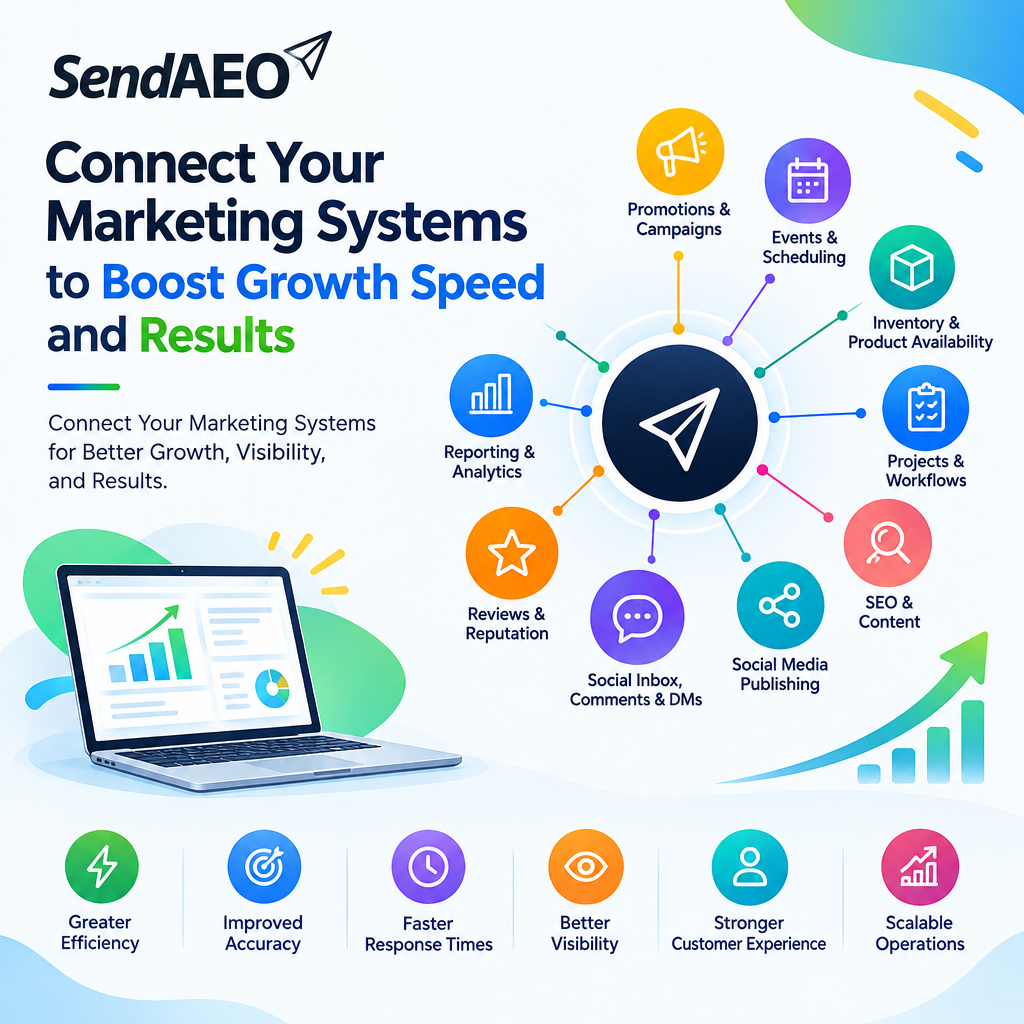
TL;DR: When your promotions, events, inventory, projects, SEO, social media publishing, social inbox, comments, reviews, and reporting all operate in separate tools, marketing becomes slower, less accurate, and harder to scale. A connected marketing system helps everything work together, so updates happen faster, messaging stays consistent, teams save time, and leadership gets a clearer view of performance. We help businesses connect the platforms, workflows, and data that power modern marketing, creating streamlined systems that improve efficiency, customer experience, campaign execution, and long-term growth.
Modern marketing depends on more than creative campaigns and regular posting. It depends on systems that can communicate with each other. Many businesses already have the tools they need, but those tools often operate in isolation. Promotions may live in one platform, event details in another, inventory updates somewhere else, and social engagement in multiple dashboards. SEO efforts may be managed independently from content production. Customer reviews may sit in a separate workflow from the team responsible for brand reputation. Project tracking might be disconnected from campaign execution.
Over time, disconnected systems create friction. Teams duplicate work, publish outdated information, miss opportunities for engagement, and struggle to maintain a unified marketing strategy. The result is not only inefficiency, but also a weaker customer experience. Audiences notice when promotions do not match landing pages, when social content references products that are no longer available, when event messaging is inconsistent, or when reviews and comments go unanswered.
Connecting your marketing systems changes that. Instead of forcing your team to manually move information from one place to another, integrated workflows make sure the right updates reach the right channels at the right time. This creates a stronger marketing engine—one that is faster, more coordinated, and much easier to measure.
Why Connected Marketing Systems Matter
Businesses rarely struggle because they lack effort. More often, they struggle because effort is being spent in too many disconnected places. A marketing team may be doing great work, but if data, content, scheduling, approvals, publishing, and customer engagement are fragmented, performance is limited by process problems rather than strategy.
Connected systems solve several critical issues at once. They reduce manual entry, improve campaign accuracy, speed up collaboration, and support a more consistent customer journey. They also help leadership make smarter decisions by bringing marketing activity and business data into a clearer view. Instead of relying on assumptions, you can see what is happening across channels and respond quickly.
This matters whether your business is running seasonal promotions, coordinating events, managing changing inventory, publishing content for search visibility, responding to social messages, or monitoring public feedback. The more moving parts you have, the more valuable integration becomes.
What a Connected Marketing Ecosystem Can Include
A connected marketing ecosystem is not limited to one platform or one department. It is a structured approach to making your essential systems work together. Depending on your business model, this can include a wide range of tools, channels, and operational workflows.
Promotions and Campaign Management
Promotional campaigns often involve email, website updates, social posts, paid media, landing pages, and internal coordination. When those elements are connected, your campaigns launch more smoothly and stay aligned from start to finish.
Events and Scheduling
Event marketing works best when calendars, registration details, promotional content, internal deadlines, and follow-up communication all stay synchronized across systems.
Inventory and Product Availability
Marketing loses credibility when products or offers are promoted after stock changes. Integrated inventory-aware marketing helps align campaigns with what customers can actually buy.
Project Management and Team Workflows
Marketing projects require coordination between stakeholders, writers, designers, account managers, executives, and technical teams. Connected project workflows reduce confusion and improve accountability.
SEO and Content Operations
Search visibility improves when keyword planning, content development, technical updates, publishing schedules, and performance reporting are connected rather than managed separately.
Social Media Posting and Approval Workflows
Scheduling, approvals, creative assets, and message consistency become easier to manage when social publishing tools connect to broader campaign and content systems.
Social Inbox, Comments, and Direct Engagement
Incoming messages, comments, and mentions should not be scattered across platforms. A centralized response workflow helps your team engage faster and protect brand reputation.
Reviews and Reputation Management
Online reviews influence trust, rankings, and conversion rates. Connected reputation systems make it easier to monitor feedback, assign responses, and identify service trends.
Common Problems Caused by Disconnected Marketing Tools
Businesses often feel the symptoms of disconnected systems before they identify the cause. If your team experiences repeated communication gaps, delays, or inconsistent reporting, the issue may not be the people or the strategy. It may be the structure of the system itself.
- Promotions are launched with outdated prices, inventory, or deadlines.
- Social content is approved late because assets and approvals live in different places.
- SEO content is published without coordination with campaigns or sales priorities.
- Comments, messages, and reviews are missed because no one has a centralized view.
- Reporting takes too long because data must be gathered manually from multiple platforms.
- Project deadlines slip because task ownership is unclear.
- Brand messaging varies across channels because updates are not distributed consistently.
- Leadership cannot easily see how activity connects to business outcomes.
These problems are extremely common, especially for growing businesses. The good news is that they are solvable with the right structure, planning, and implementation.
Solutions We Offer to Connect Marketing Systems
Every business has a different combination of tools, workflows, and goals. That is why connected marketing solutions should not be one-size-fits-all. The right approach starts with understanding how your business currently operates, where friction exists, and which integrations will create the most value first.
We help businesses design and implement practical, scalable marketing systems that support both daily operations and long-term growth. Our solutions are built around real business needs, not just software features.
How Connected Systems Improve Day-to-Day Marketing
Integration is not just a technical improvement. It changes how marketing functions every day. Teams spend less time chasing updates and more time improving strategy, creative quality, and customer communication. The speed and clarity created by connected systems often lead to better execution across the board.
For example, when promotions are connected to content calendars and social scheduling, teams can avoid last-minute scramble. When inventory data influences campaign logic, businesses reduce the risk of promoting unavailable products. When project tasks connect to campaign milestones, managers gain visibility into what is on track and what needs attention. When customer reviews and comments are centralized, response times improve and issues are resolved before they become larger reputation concerns.
This kind of structure also supports better collaboration between departments. Marketing, operations, sales, customer service, and leadership all benefit when information flows more reliably. Instead of reacting to problems created by disconnected tools, your team can focus on delivering stronger customer experiences and better business outcomes.
Benefits of Marketing Integration for Growing Businesses
Greater Efficiency
Reduce repetitive manual work, simplify coordination, and free up time for higher-value marketing activity.
Improved Accuracy
Keep promotions, event details, product information, and campaign messaging more consistent across channels.
Faster Response Times
Centralized inboxes and streamlined workflows help your team respond more quickly to comments, reviews, and direct messages.
Better Visibility
Stronger reporting structures make it easier to understand what is working and where adjustments are needed.
Stronger Customer Experience
Customers receive more consistent messaging, timely updates, and better support across your digital presence.
Scalable Operations
As your business grows, connected systems make it easier to manage more campaigns, channels, and customer interactions without added chaos.
Our Approach to Building Connected Marketing Systems
Effective integration starts with strategy, not software. Before making changes, it is important to understand the business goals behind the work. Some businesses need faster campaign execution. Others need more accurate promotional workflows, better visibility into SEO performance, stronger social engagement processes, or cleaner reporting across teams.
Our approach is built around identifying those priorities first. From there, we map the systems involved, determine how information should move, and create an implementation plan that fits your operations. We focus on practical improvements that reduce friction, support your team, and create real operational value.
We also understand that not every problem requires a complete system overhaul. In many cases, meaningful results come from improving key workflows, clarifying responsibilities, connecting a few high-impact platforms, and creating better reporting visibility. The goal is not unnecessary complexity. The goal is a smarter, more connected marketing operation.
Use Cases Across Marketing and Operations
Connected systems can support a wide range of business scenarios. A retailer may need promotions tied to inventory availability and local social posting. A service-based business may want SEO content, reviews, and lead follow-up organized more effectively. A company hosting frequent events may need registration, reminders, social media promotion, and post-event nurture sequences aligned. A multi-location business may need brand consistency across publishing, reviews, and comment monitoring.
In each case, the principle is the same: reduce fragmentation, improve communication, and create workflows that support execution without requiring constant manual intervention. When the underlying systems work together, your marketing becomes more resilient, more agile, and more measurable.
Why This Matters for SEO, Social Media, and Reputation
Search performance, social media activity, and reputation management are often treated as separate disciplines. In practice, they influence each other constantly. Strong SEO brings visitors to your site, but the customer experience must support conversion. Social media builds awareness and engagement, but promotional accuracy and response management affect trust. Reviews shape public perception and local visibility, while internal workflows determine how quickly and effectively your team responds.
A connected approach helps these areas support each other instead of competing for attention. Content planning can reflect seasonal offers and search demand. Social publishing can amplify SEO-driven content and event campaigns. Reviews and customer feedback can reveal content gaps, service issues, or new topics worth targeting. Integrated reporting can show how these efforts contribute to traffic, engagement, and lead quality over time.
How We Help You Move from Fragmented to Connected
If your business is dealing with too many platforms, inconsistent updates, slow approvals, scattered social engagement, or unclear performance reporting, the solution is not simply adding another tool. The solution is designing a more connected system around the tools and workflows that matter most to your business.
We help identify where the biggest gaps are, where integration will create the most immediate value, and how to implement improvements in a way that your team can actually use. Whether the need involves promotions, events, inventory-aware marketing, project coordination, SEO operations, social posting, social inbox management, comments, reviews, or reporting, we build practical solutions that support day-to-day execution as well as long-term strategy.
The result is a marketing environment that is easier to manage, easier to measure, and better equipped to support growth.
Frequently Asked Questions
What does it mean to connect marketing systems?
It means making the tools, platforms, and workflows used in your marketing operations work together more effectively. This can include connecting promotions, content calendars, social publishing, inbox management, reviews, inventory data, event workflows, project tracking, and reporting.
Why are disconnected marketing tools a problem?
Disconnected tools create delays, duplicate work, inconsistent messaging, missed customer engagement, and reporting challenges. They also make it harder for teams to execute campaigns accurately and scale operations efficiently.
Can connected systems help with SEO?
Yes. SEO improves when keyword planning, content production, technical updates, publishing schedules, and performance reporting are aligned with broader marketing activity. Connected workflows help ensure that search strategy supports real business priorities.
How do integrated systems improve social media management?
Integrated systems make it easier to plan content, manage approvals, organize assets, publish consistently, monitor messages and comments, and report on results. This reduces manual work and helps teams respond faster.
Can you help manage reviews and online reputation?
Yes. Review and reputation workflows can be structured so feedback is monitored, responses are assigned, trends are identified, and customer concerns are escalated appropriately. This supports both trust and operational improvement.
Do businesses need to replace all their current tools?
Not usually. In many cases, the best solution is to improve how your current systems work together. The focus should be on reducing friction and improving visibility, not replacing tools unnecessarily.
What types of businesses benefit from connected marketing systems?
Nearly any business with multiple marketing channels, recurring campaigns, events, inventory changes, customer engagement activity, or cross-team coordination can benefit. Integration is especially valuable for growing businesses that need more consistency and scalability.
How do you get started with a marketing systems integration project?
The first step is understanding your current tools, workflows, business goals, and areas of friction. From there, priorities can be mapped, integration opportunities identified, and a practical implementation plan created.