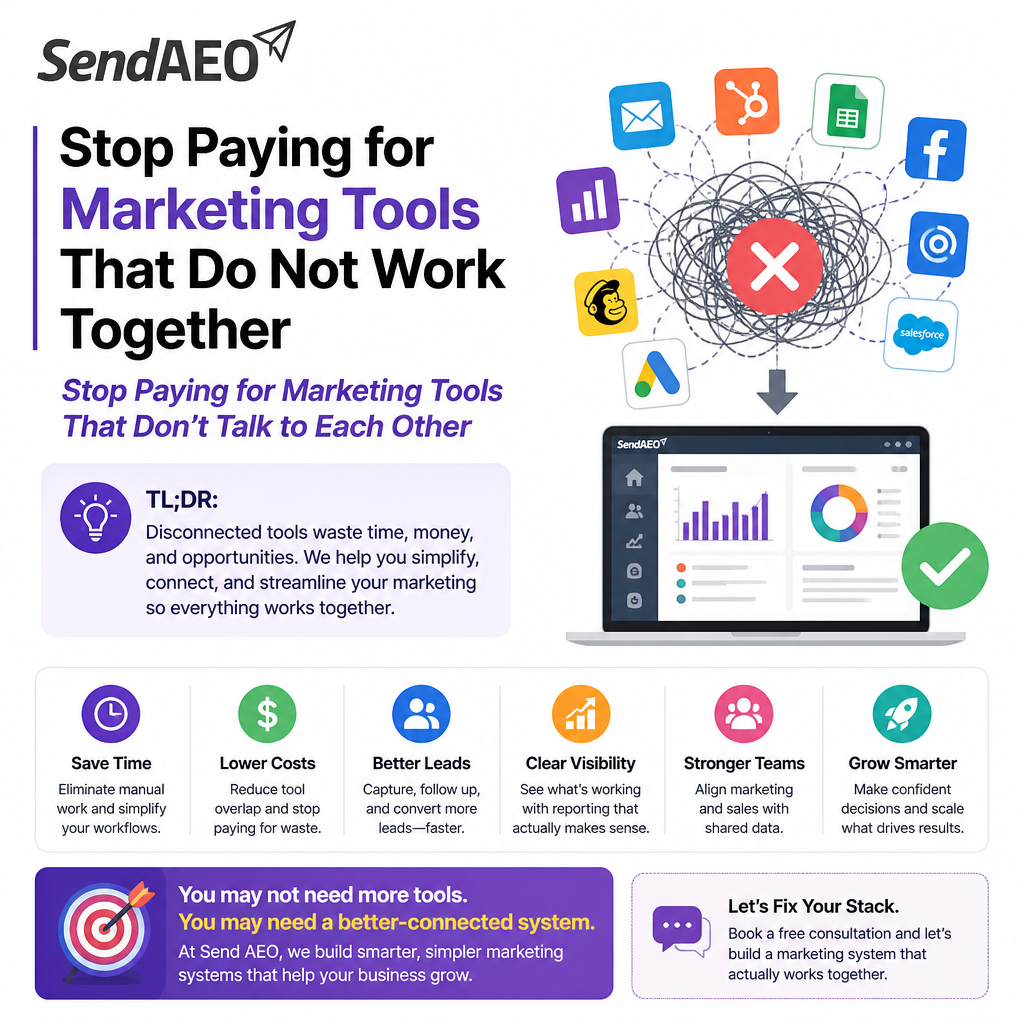
Stop Paying for Marketing Tools That Do Not Work Together
Stop Paying for Marketing Tools That Don’t Talk to Each Other
TL;DR: If your business is paying for separate marketing tools that don’t share data, work together, or give you a clear picture of results, you are likely wasting time, money, and opportunities. Many companies end up with disconnected software for email, ads, CRM, analytics, lead tracking, reporting, and automation. The result is confusion, duplicated work, missed follow-ups, and poor decision-making. From an agency perspective, the best solution is not always “more tools.” It is building a smarter, simpler, connected marketing system that supports your goals. At Send AEO, we help clients reduce tool overload, improve visibility, streamline operations, and create marketing systems that actually work together in plain, practical ways.
It happens all the time.
A business starts with one marketing platform. Then another gets added for email. Another for CRM. Another for social scheduling. Another for ad reporting. Another for landing pages. Another for automation. Before long, the company is paying for a stack of tools that all promise growth, but none of them truly work together.
On paper, it looks like a modern marketing setup. In reality, it often becomes a patchwork system filled with manual work, missing data, and constant frustration.
From our agency perspective, this is one of the most common and costly problems we see. Businesses are not always struggling because they lack tools. They are struggling because their tools are disconnected.
If your team is copying data from one platform to another, chasing reports across dashboards, or trying to figure out which campaign actually generated revenue, your marketing tech stack may be working against you.
This article explains why disconnected marketing tools create hidden costs, how to recognize the warning signs, and how we help businesses simplify and connect their systems so marketing becomes easier to manage and easier to grow.
Why Disconnected Marketing Tools Cost More Than You Think
Most businesses notice the monthly subscription costs first. Maybe it is a few hundred dollars here, a few hundred there, and a premium platform on top of that. But the bigger cost is usually not the software bill alone.
The real cost shows up in things like:
- Leads falling through the cracks
- Sales teams not seeing full customer history
- Marketing teams wasting hours building reports manually
- Duplicate contacts across platforms
- Inconsistent messaging across channels
- Missed automation opportunities
- Slow response times to new inquiries
- Poor attribution and unclear return on investment
When tools do not “talk” to each other, your team becomes the connection point. That means people are forced to do the job software was supposed to handle. That creates inefficiency, errors, and burnout.
In simple terms, disconnected tools make marketing harder than it needs to be.
What “Tools That Don’t Talk to Each Other” Really Means
Not every client uses technical language, so let’s keep this straightforward.
When we say your marketing tools do not talk to each other, we mean the systems you pay for are not automatically sharing useful information in a reliable way.
For example:
- Your website form collects a lead, but that lead does not automatically appear correctly in your CRM
- Your CRM has customer data, but your email tool is not using that data for better targeting
- Your ad platform generates conversions, but your reporting tool cannot tie them back to real sales
- Your scheduling tool shows campaign activity, but your analytics do not show the customer journey from click to purchase
- Your team has to export and import spreadsheets just to keep records updated
These problems might sound small individually, but together they create a messy system that limits growth.
The Common Signs Your Marketing Stack Is Too Fragmented
Many business owners get used to marketing chaos and assume it is normal. It is not. If any of the situations below sound familiar, there is a good chance your systems need attention.
1. You Have Too Many Dashboards
If checking marketing performance means logging into five, six, or ten different platforms, you probably do not have a real reporting system. You have scattered data.
2. Your Team Is Doing Manual Data Entry
If someone on your team regularly copies leads, campaign information, contact records, or performance numbers from one system to another, that is a red flag. Manual work increases errors and slows everything down.
3. You Cannot Clearly See What Is Driving Revenue
Getting clicks and leads is one thing. Knowing which campaigns, channels, and messages actually create paying customers is another. If your tools are disconnected, revenue attribution becomes murky fast.
4. Leads Get Lost or Delayed
Fast follow-up matters. If a lead comes in and there is any delay before it reaches the right person, your conversion rate can suffer. Disconnected tools often create handoff issues that cost real business.
5. Your Marketing and Sales Teams Are Looking at Different Information
When teams use separate systems that are not aligned, they end up making decisions based on incomplete or conflicting data. That leads to finger-pointing and poor coordination.
6. You Keep Adding New Tools Instead of Fixing the System
Sometimes businesses try to solve a process problem by buying another platform. But if the foundation is already disconnected, one more tool usually adds more complexity, not less.
Why This Happens So Often
There is a reason so many businesses end up here.
Marketing software is usually purchased one need at a time. A company needs email marketing, so they buy one tool. Then they need customer management, so they buy another. Then they need better reporting, automation, landing pages, call tracking, text messaging, and ad insights. Each tool solves one immediate problem, but few decisions are made with the whole ecosystem in mind.
Over time, the stack becomes bloated and disconnected.
This is especially common when:
- Different team members choose their own platforms
- There is no long-term marketing systems strategy
- The business outgrows its original setup
- Old tools remain in place “just in case”
- Integrations were never properly configured or maintained
- Reporting needs evolve faster than the tech setup
None of this means your team made bad decisions. It usually means your business grew, your needs changed, and your systems were never fully realigned.
The Hidden Business Problems Behind a Disconnected Stack
This issue is not just about convenience. It affects business performance in meaningful ways.
Lower Marketing ROI
If you cannot confidently connect spending to outcomes, you will struggle to know what to scale, what to fix, and what to cut.
Wasted Staff Time
Your team should be focused on strategy, creative work, and customer engagement, not wrestling spreadsheets and chasing updates across tools.
Poor Customer Experience
When systems are fragmented, prospects may receive slow responses, repeated messages, or irrelevant communication that makes your brand look disorganized.
Weak Decision-Making
Leaders need clarity. If data is incomplete or delayed, decisions about budget, staffing, and growth become much harder.
In other words, disconnected marketing tools do not just create technical headaches. They reduce your ability to market effectively and grow predictably.
What Clients Actually Want Instead
Most clients are not asking for a bigger software stack. They want something much simpler:
- A clear view of what is working
- Faster lead handling
- Less manual work
- Better coordination between marketing and sales
- More confidence in reporting
- A system that can grow with the business
That is why we approach this from a systems perspective, not just a tool perspective.
The goal is not to impress clients with a long list of platforms. The goal is to help them create a connected marketing engine that supports real business outcomes.
How We Help Clients Simplify and Connect Their Marketing Systems
At Send AEO, we work with clients to remove friction from their marketing operations. That often starts by stepping back and looking at the full picture rather than focusing on one isolated platform.
Here is how we typically help.
1. We Audit the Current Stack
Before recommending anything, we look at what tools a client is currently using, what each one does, where data is flowing, and where it is getting stuck. This often reveals duplicate tools, underused features, unnecessary subscriptions, and broken processes.
Many clients are surprised to learn they are paying for overlapping functionality in multiple systems.
2. We Identify Gaps, Bottlenecks, and Waste
Once we understand the stack, we pinpoint the biggest issues. Maybe leads are not syncing correctly. Maybe campaign reporting is disconnected from revenue data. Maybe the business has automation tools but no practical automation running. We focus on the problems that affect efficiency and performance most.
3. We Recommend a More Connected Approach
Sometimes the right move is better integration. Sometimes it is consolidation. Sometimes it means replacing one or two tools with a cleaner, more efficient setup. We help clients make sense of their options in plain English, without unnecessary jargon.
4. We Build Practical Workflows
A connected system is not just about software. It is about how information moves through your business. We help create workflows for lead capture, follow-up, nurturing, reporting, and customer communication so your marketing operations run more smoothly.
5. We Improve Visibility and Reporting
One of the biggest wins for clients is clarity. We help organize data so it becomes easier to understand which efforts are generating leads, which leads are converting, and where opportunities are being lost.
6. We Focus on Real Business Outcomes
We are not interested in adding technology just for the sake of technology. Our role is to help clients create a more usable, measurable, scalable marketing system that supports lead generation, conversions, and long-term growth.
What This Looks Like in Everyday Terms
Let’s make this even more practical.
A connected marketing system can mean:
- A lead fills out a form and instantly appears in the right place with the right tags and notifications
- Your sales team can see where the lead came from and what content or campaign brought them in
- Follow-up emails or messages go out automatically based on real behavior
- Reporting shows not just leads, but qualified leads and actual customer outcomes
- Your team spends less time pulling reports and more time improving campaigns
- You know which channels deserve more budget because performance is easier to measure
That kind of setup reduces chaos and gives businesses more control over their marketing.
Why an Agency Perspective Matters
When you are inside your own business every day, it is easy to adapt to workarounds without realizing how much they are costing you. An outside agency perspective can help uncover issues that have become normal internally.
We often see problems like:
- Tools purchased years ago that no longer fit current needs
- Reporting based on vanity metrics instead of business outcomes
- Sales and marketing data living in separate silos
- Automations that were started but never completed
- Multiple subscriptions doing nearly the same job
Because we look across strategy, systems, content, operations, and performance, we can help clients connect the dots. That perspective matters because growth rarely comes from one isolated fix. It comes from having the right parts working together.
You May Not Need More Tools. You May Need Fewer, Better-Connected Ones.
This is one of the biggest mindset shifts for clients.
Marketing technology should create leverage. It should help your business do more with less friction. If it is doing the opposite, adding another subscription is rarely the answer.
In many cases, businesses can improve performance by:
- Eliminating redundant tools
- Improving existing integrations
- Fixing broken data flows
- Aligning systems with actual business processes
- Creating cleaner reporting structures
- Making better use of platforms they already pay for
That often leads to lower costs, better efficiency, and stronger marketing results at the same time.
The Benefits of a Connected Marketing Ecosystem
When your tools and processes are aligned, the benefits reach across the business.
| Area | Benefit |
|---|---|
| Lead Management | Faster response times and fewer missed opportunities |
| Reporting | Clearer visibility into campaign performance and ROI |
| Team Efficiency | Less manual work and fewer process bottlenecks |
| Customer Experience | More relevant, timely, and consistent communication |
| Decision-Making | Better data for smarter budgeting and growth planning |
| Scalability | Systems that can support growth without adding unnecessary complexity |
What to Do If You Suspect Your Tools Are Holding You Back
If this article sounds familiar, the first step is not panic. It is clarity.
Start by asking a few basic questions:
- What marketing tools are we currently paying for?
- What does each one actually do?
- Where does lead and customer data live?
- Which systems are connected, and which are not?
- How much manual work is happening each week?
- Can we clearly trace marketing efforts to revenue?
- Are we using these tools fully, or just partially?
Those questions alone can reveal a lot.
From there, the right move is usually a structured review of your marketing ecosystem so you can decide what to keep, what to improve, and what to remove.
How Send AEO Supports Clients Through This Process
At Send AEO, we help businesses move from fragmented marketing systems to smarter, more connected operations. We understand that most clients do not want technical complexity. They want practical solutions that save time, reduce waste, and support growth.
Our role is to help simplify what feels messy, identify what is not working, and create a more connected path forward. That may involve strategy, systems review, process improvement, campaign alignment, reporting clarity, and better use of the tools you already have.
We speak in plain language, focus on what matters most, and build solutions around business outcomes rather than software hype.
If your marketing tools feel scattered, your data feels incomplete, or your reporting feels harder than it should be, there is a better way to work.
Final Thoughts
Paying for multiple marketing tools is not automatically a problem. Paying for multiple tools that do not work together is. When systems are disconnected, businesses lose time, visibility, efficiency, and revenue opportunities. The good news is that this problem can be fixed. With the right strategy and support, you can simplify your stack, improve how your tools communicate, and build a marketing system that helps your business move faster and make better decisions. That is the kind of practical, growth-focused support we aim to provide at Send AEO.
Frequently Asked Questions
How do I know if I have too many marketing tools?
A common sign is that your team is logging into multiple platforms to do simple tasks, pulling manual reports, or struggling to track leads from first contact to sale. If your tools create confusion instead of clarity, you likely have a stack problem.
Are disconnected marketing tools really that expensive?
Yes, and not just because of monthly subscriptions. The bigger cost often comes from wasted staff time, missed leads, reporting errors, slow follow-up, duplicate work, and unclear ROI.
Should I replace all of my current tools?
Not necessarily. In many cases, the better solution is to improve integrations, remove overlap, and make better use of what you already have. A full replacement is sometimes needed, but it should be based on strategy, not frustration alone.
What is the biggest risk of disconnected systems?
One of the biggest risks is losing visibility into what is actually driving business results. Without connected systems, it becomes much harder to track lead sources, conversion paths, and marketing return on investment.
Can an agency help even if we already have an internal team?
Absolutely. An agency can provide an outside perspective, identify inefficiencies your team may be too close to see, and help build a more connected system that supports both marketing and sales efforts.
What kind of businesses benefit most from a connected marketing system?
Almost any growing business can benefit, especially those using several platforms for lead generation, CRM, reporting, content, automation, and campaign management. The more moving parts you have, the more valuable a connected system becomes.
How can Send AEO help with marketing tool overload?
Send AEO helps businesses evaluate their current setup, uncover inefficiencies, simplify their marketing systems, improve workflows, and build a more connected strategy focused on measurable business outcomes.
What should we do first if our marketing stack feels messy?
The best first step is a clear audit of your tools, workflows, and reporting setup. Once you know what each platform is doing and where the disconnects are, it becomes much easier to decide what needs to change.