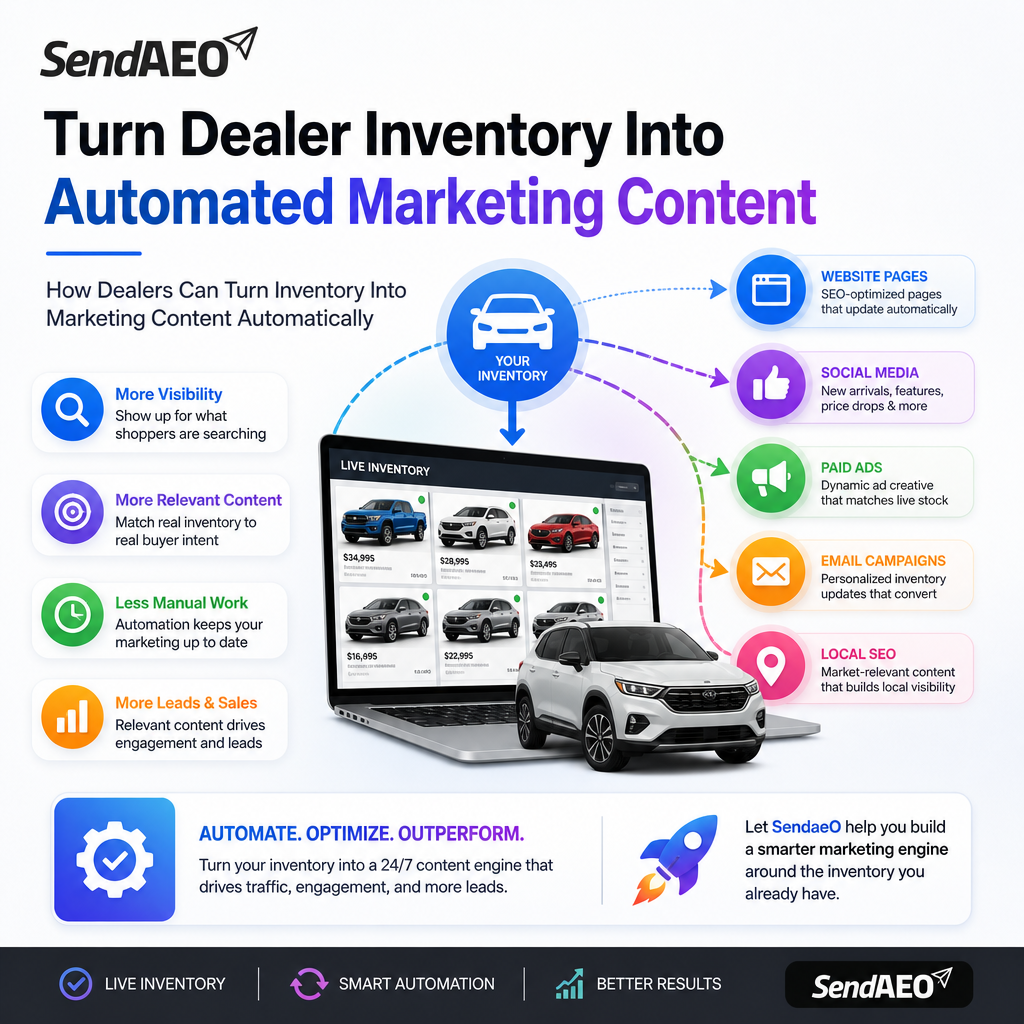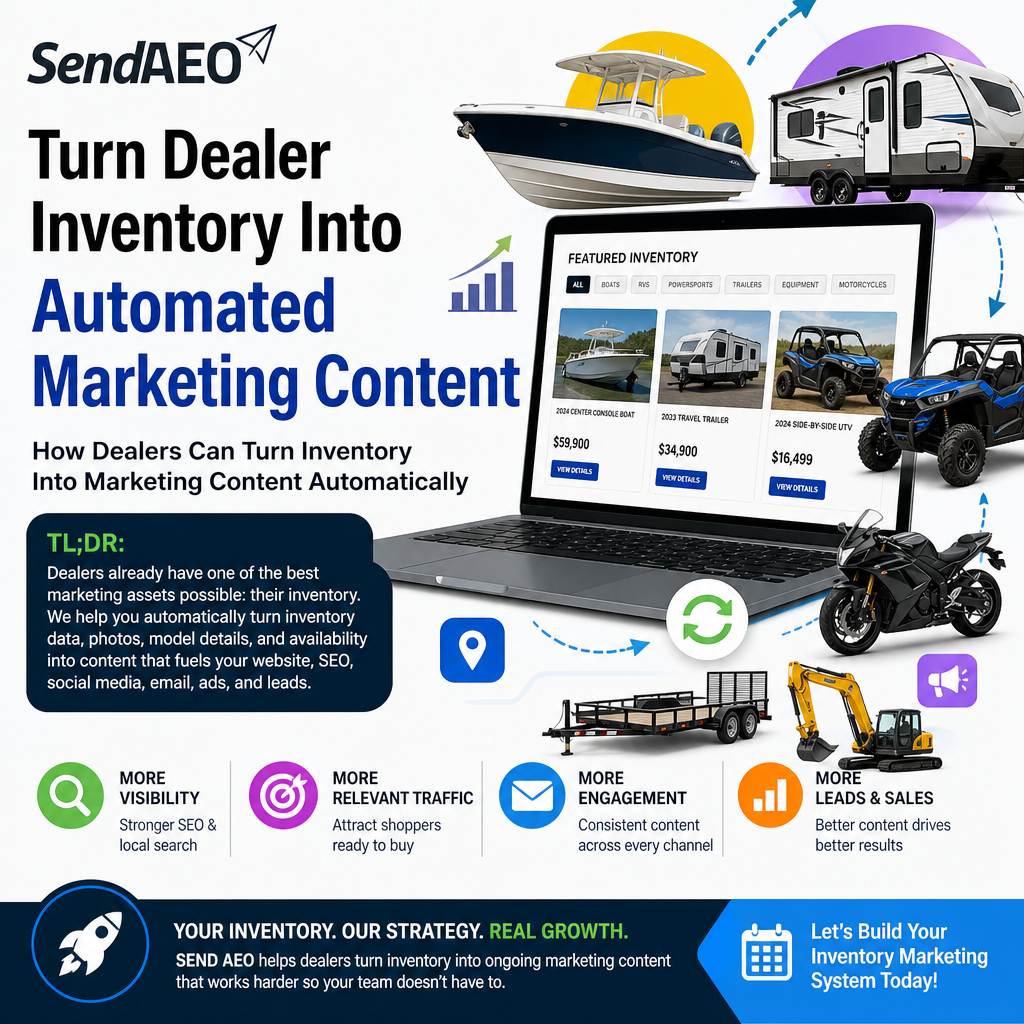
Turn Dealer Inventory Into Automated Marketing Content
How Dealers Can Turn Inventory Into Marketing Content Automatically
TL;DR: Dealers in boating, RV, powersports, trailers, equipment, and motorcycles already have one of the best marketing assets possible: their inventory. Every unit on your lot or showroom can become useful marketing content for your website, search visibility, social media, paid campaigns, email marketing, and lead generation. Instead of relying on random posts or constantly reinventing your content calendar, a smarter approach is to automatically turn inventory data, photos, model details, and availability into consistent, scalable marketing content. From an agency perspective, this helps dealers save time, stay active online, improve SEO, attract better shoppers, and create more opportunities for leads and sales. At SEND AEO, we help dealers use automation and strategic content systems to transform inventory into ongoing marketing output that supports growth without creating extra work for the dealership team.
For many dealerships, marketing feels like a separate job from selling inventory. The sales team is focused on moving units. The operations team is focused on keeping things organized. Management wants more leads, more traffic, and more sales. Meanwhile, marketing often becomes a scramble to post something on social media, update the website, write an email, or launch a campaign before the next weekend promotion.
The challenge is not that dealers lack material. In fact, most dealers are sitting on a steady stream of highly marketable content every single day. The real problem is that inventory data is often treated only as operational information instead of marketing fuel.
From our marketing agency perspective, this is one of the biggest missed opportunities in the dealership world. Whether you sell boats, RVs, ATVs, side-by-sides, motorcycles, trailers, or equipment, your inventory is already full of content customers want to see. Buyers are actively looking for specific makes, models, features, price points, conditions, and use cases. If your inventory can be turned into marketing content automatically, your dealership can stay visible, relevant, and competitive without needing to build every campaign from scratch.
Why Inventory Is One of the Best Marketing Assets a Dealer Has
When people shop for major recreational or utility purchases, they rarely start by looking for a marketing slogan. They search for products. They want to know what is available, what it looks like, what features it has, what condition it is in, how much it costs, and whether it fits their needs.
That means your inventory naturally matches how people search online. A consumer may search for:
- used center console boat near me
- travel trailer with bunkhouse
- side-by-side for hunting
- utility trailer with ramp gate
- compact excavator for small jobs
- touring motorcycle under a certain budget
These are not abstract branding searches. They are product-driven searches with purchase intent. That is why inventory-based content can be so powerful. It speaks directly to what real shoppers are trying to find.
Every listing, model page, feature breakdown, availability update, image set, and category collection has the potential to bring in traffic and generate interest. When organized properly, your inventory can support:
- Search engine visibility
- Local SEO relevance
- Vehicle or unit discovery
- Landing pages for paid ads
- Email campaigns
- Social media posts
- Retargeting campaigns
- Sales team follow-up
- Seasonal promotions
Instead of thinking of inventory as something that only lives in your website listings, think of it as the raw material for a complete marketing system.
The Traditional Problem: Manual Marketing Does Not Scale
Most dealerships do not struggle because they do not care about marketing. They struggle because manual marketing takes too much time.
Here is what often happens:
- Someone uploads inventory to the website.
- Someone else tries to remember to post a few units on social media.
- An email goes out only when there is a sale event.
- Ads are built around broad messaging instead of specific in-stock products.
- Website content becomes thin, repetitive, or outdated.
- Units arrive or sell before marketing catches up.
This creates inconsistency, and inconsistency is one of the biggest reasons dealerships fail to get better results online. Even good teams struggle to keep up when content depends on people manually rewriting the same information over and over again.
From an agency standpoint, the answer is not simply telling dealerships to “post more.” The answer is creating a process where the inventory itself drives the marketing.
What It Means to Turn Inventory Into Marketing Content Automatically
Automation does not mean replacing strategy. It means removing repetitive tasks so strategy can actually work.
When inventory is turned into marketing content automatically, the dealership uses available product information such as make, model, year, condition, category, photos, features, pricing, and stock status to create multiple forms of content without having to manually build each one from nothing.
This can include:
- Optimized inventory detail pages
- Search-friendly category pages
- New arrival content
- Featured inventory collections
- Location-based listing content
- Email content based on in-stock units
- Social media post variations
- Paid ad creatives and product-focused landing pages
- Blog-style content built around inventory trends and buyer interests
The key is that the content output is based on real inventory data, not guesswork. This keeps the marketing relevant, timely, and aligned with what shoppers can actually buy right now.
Why This Matters for Boat, RV, Powersports, Trailer, Equipment, and Motorcycle Dealers
These industries have a lot in common. Purchases are often high-consideration decisions. Inventory changes frequently. Photos matter. Features matter. Seasonal timing matters. Location matters. And customers often compare many options before reaching out.
That is exactly why automated inventory-based content works so well.
Boat dealers can highlight hull types, lengths, engine packages, fishing features, family-friendly layouts, and seasonal availability.
RV dealers can market floorplans, sleeping capacity, slide-outs, towability, travel styles, and new arrival inventory for family trips or long-distance travel.
Powersports dealers can showcase use cases such as trail riding, utility work, performance riding, hunting, or recreation, all based on specific units in stock.
Trailer dealers can create content around trailer type, hauling purpose, size, axle setup, gates, ramps, and practical applications.
Equipment dealers can generate content based on machine category, job type, durability, attachments, and business use cases.
Motorcycle dealers can publish content focused on riding style, engine size, comfort, budget, new versus used options, and rider experience.
In every case, the same principle applies: shoppers want useful information tied to available inventory. The more efficiently a dealership can provide that information, the more opportunities it creates to get found and win attention.
The Real Benefits of Automated Inventory-Based Marketing
1. More Consistent Content Without More Work
One of the hardest parts of dealership marketing is consistency. Automated inventory content helps solve that by continuously generating fresh marketing material from what is already entering your system. New units, price changes, featured categories, and updated availability can all create natural content opportunities.
2. Better SEO From Content Shoppers Actually Want
Search engines reward relevant, useful content. Inventory-based content naturally includes the product terms and details people search for. Instead of publishing vague content that may not match buyer intent, dealerships can build pages and content around specific products, categories, and needs. This can strengthen long-tail search visibility and help attract more qualified traffic.
3. Improved Local Visibility
Many dealership purchases happen locally or regionally. When inventory content includes location signals, local market relevance, and practical search phrasing, it can support stronger local discovery. People often search for units “near me” or in a specific city or region, especially when they are closer to buying.
4. More Relevant Social Media
Dealership social media often gets stuck between brand posts and event announcements. Inventory gives you a constant source of relevant content. Instead of generic posts, you can highlight actual units in stock, compare options, promote new arrivals, and create posts around common buyer needs. This usually performs better because it is more concrete and useful.
5. Stronger Paid Campaign Performance
Ads tend to work better when they lead shoppers to pages that closely match what they clicked on. If your campaigns can automatically feature real inventory with strong landing pages behind them, the user experience improves. That can lead to better engagement, stronger lead quality, and more efficient ad spend.
6. Faster Response to Inventory Changes
Inventory changes quickly. Marketing that depends on manual effort often lags behind. Automated systems can help dealerships promote what is currently available, reduce attention on sold units, and quickly shift focus to fresh arrivals or priority inventory.
7. Better Use of Existing Photos and Data
Most dealers already have photos, specifications, titles, categories, and basic descriptions. The problem is that these assets are not always being used to their full marketing potential. Automation helps expand the value of what you already have.
What Kinds of Marketing Content Can Come From Inventory?
Dealers are often surprised by how many content types can be created from inventory data when there is a good process behind it. Here are some of the most valuable examples.
Inventory Detail Pages
These are the foundation. A unit page should do more than list specs. It should help a shopper understand what the unit is, who it may be good for, what stands out, and why they should take the next step. Better pages help both users and search engines.
Category and Collection Pages
Instead of only relying on individual unit pages, dealerships can also build collection pages around categories and buyer interests. Examples might include fishing boats, bunkhouse travel trailers, enclosed cargo trailers, compact tractors, beginner motorcycles, or family-friendly side-by-sides.
New Arrival Spotlights
Every new arrival is a content opportunity. Dealerships can automatically feature recent additions in website content, email campaigns, or social posts to keep shoppers engaged and encourage repeat visits.
Price Drop and Featured Inventory Content
When units are discounted or prioritized, that information can be turned into marketing content quickly. This helps move aged inventory while keeping promotions tied to actual units.
Buyer-Focused Educational Content
Inventory can support educational content too. For example, instead of writing broad articles disconnected from sales, you can create content around choosing the right type of trailer, comparing equipment options for certain jobs, or understanding the difference between types of motorcycles, while naturally featuring relevant in-stock units.
Email Content
Inventory-based emails can be far more useful than generic newsletters. Dealers can send new inventory alerts, featured unit collections, category highlights, or seasonal recommendations based on current stock and buyer interest.
Social Posts
Social media becomes much easier when inventory is the content source. Instead of wondering what to post, a dealership can consistently showcase new arrivals, top categories, staff picks, budget-friendly options, or use-case-based groupings.
Paid Ad Creative and Landing Pages
Inventory-driven ads work especially well when matched with inventory-focused landing pages. This keeps the message aligned and can reduce friction for shoppers who are ready to browse or inquire.
What Dealers Often Get Wrong
Even dealerships with strong inventory and decent traffic often miss the full opportunity because of a few common issues:
- Using duplicate or overly thin descriptions
- Posting inconsistent inventory details
- Failing to build content around categories and buyer intent
- Relying on generic branding instead of product relevance
- Letting sold inventory pages disappear without strategy
- Not using photos and specs beyond the listing page
- Creating content manually so often that marketing falls behind
In simple terms, many dealers have the raw material but not the system. That is where the right agency support can make a major difference.
What a Good Automated Inventory Marketing System Looks Like
From a client perspective, the goal is not to make marketing feel more technical. The goal is to make it easier, more reliable, and more effective.
A strong system usually includes:
- A clean flow of inventory data from your source systems
- Structured page content for individual units and categories
- SEO-minded formatting and on-page optimization
- Automatic content triggers for new arrivals, featured units, and updates
- Reusable content frameworks for social, email, and campaigns
- Clear calls to action for leads and inquiries
- Oversight to maintain quality, accuracy, and brand consistency
Automation should not create robotic marketing. It should create an efficient framework where your inventory can be presented clearly and professionally at scale.
How This Helps the Sales Process, Not Just Marketing
It is important to remember that better inventory content is not just a traffic strategy. It also helps your sales team.
When shoppers arrive on your site and find useful, well-organized, up-to-date inventory content, they are more likely to:
- Stay on the website longer
- View multiple units
- Submit a lead form
- Call with a more informed question
- Visit the dealership with stronger purchase intent
This can improve lead quality because customers are engaging with actual products rather than broad awareness messaging. In other words, automated inventory marketing can help move people further down the buying process before they even speak to your team.
Why Agency Guidance Still Matters Even With Automation
Automation is powerful, but it works best when guided by a strategy. Simply pushing inventory data into content fields is not enough by itself. The content still needs to be organized in a way that supports SEO, user experience, brand trust, and conversions.
That is where an experienced marketing agency comes in. A good agency helps decide:
- Which inventory details matter most to shoppers
- How pages should be structured for search and usability
- How to create meaningful category and use-case content
- How to avoid repetitive, low-value content
- How to connect inventory content to campaigns and lead generation
- How to measure results and improve over time
The best outcomes happen when technology and strategy work together.
How We Can Help at SEND AEO
At SEND AEO, we help dealerships turn inventory into scalable marketing content in a way that is practical, clear, and growth-focused. We understand that dealers do not need more busywork. They need systems that make their current assets work harder.
Our approach is built around helping dealers use inventory more effectively across digital marketing channels so that available units do more than sit on a listings page. They become part of a larger content and lead generation engine.
That can include support with:
- Inventory-driven content strategy
- SEO-friendly inventory and category page optimization
- Automated content workflows
- Marketing systems that turn unit data into usable website content
- Campaign alignment between inventory, paid traffic, and lead capture
- Ongoing optimization from an agency perspective
In plain English, we help dealers market what they actually have in stock, more consistently and with less wasted effort. If your team has great inventory but struggles to turn it into steady online visibility and lead flow, this is exactly the kind of problem we are built to solve.
The Competitive Advantage of Starting Now
Many dealerships are still treating inventory and marketing as separate functions. That creates an opportunity for dealers who are ready to connect them.
The businesses that win online are often not the ones shouting the loudest. They are the ones showing the most relevant information at the right time. If your inventory is already changing every day, then your content opportunities are changing every day too.
Dealers who put automated inventory-based marketing in place can gain an advantage through:
- Fresher website content
- Better search coverage
- More useful landing pages
- More consistent social posting
- More targeted promotional messaging
- More efficient use of their marketing budget
This does not mean every piece of content should be fully automated or that branding no longer matters. It means your day-to-day marketing should be grounded in what shoppers actually care about most: available inventory and helpful information.
Final Thoughts
If you are a dealer in boats, RVs, powersports, trailers, equipment, or motorcycles, your inventory is more than a sales list. It is one of your most valuable marketing assets. When used correctly, it can fuel SEO, social media, paid campaigns, website engagement, and lead generation in a way that feels more natural and sustainable than constant manual content creation.
From our agency perspective, the smartest move is to stop treating content as something separate from your inventory operations. The two should work together. The more automatically your inventory can power your marketing, the easier it becomes to stay visible, relevant, and competitive.
If your dealership is ready to make that shift, SEND AEO can help build the strategy and systems to turn your inventory into ongoing marketing content that supports real business results.
Frequently Asked Questions
What does it mean to turn inventory into marketing content automatically?
It means using your existing inventory data, photos, model details, and unit information to create marketing content such as optimized listing pages, category pages, social posts, email content, and campaign assets without having to manually write everything from scratch every time.
Will automated content sound generic or robotic?
It can if it is done poorly. The goal is not to produce low-quality content at scale. A strong system combines automation with strategy, formatting, and quality control so the content stays useful, readable, and relevant to shoppers.
Is this only useful for large dealerships?
No. Small and mid-sized dealerships can benefit significantly because automation helps them market more consistently without needing a large in-house team. In many cases, smaller dealers gain an advantage by becoming more efficient with the inventory and resources they already have.
How does inventory-based content help SEO?
Inventory content often aligns closely with what shoppers search for, including make, model, category, features, condition, and local buying intent. That makes it a strong foundation for improving visibility in search results, especially when pages are optimized well.
Can this help with social media too?
Yes. Inventory gives dealerships a steady source of relevant social content. New arrivals, featured units, budget-friendly picks, seasonal recommendations, and use-case groupings can all be built from current stock instead of relying on random posting ideas.
What if our inventory changes too fast?
That is one of the best reasons to use automation. When inventory changes quickly, manual marketing tends to fall behind. An automated approach can help keep website content and promotions better aligned with what is actually available now.
Do used units work for this too, or only new inventory?
Both can work well. Used inventory is often especially valuable for search and shopper interest because buyers frequently look for specific pre-owned options, price points, and features. Unique used units can create strong content opportunities.
How can SEND AEO help our dealership?
SEND AEO helps dealerships build practical systems and strategies that turn inventory into ongoing marketing content. That includes helping improve inventory page content, support SEO, create automation-friendly workflows, and connect inventory marketing to lead generation goals.