Turn Car Dealer Inventory Into Automated Marketing Content
How Car Dealers Can Turn Inventory Into Marketing Content Automatically
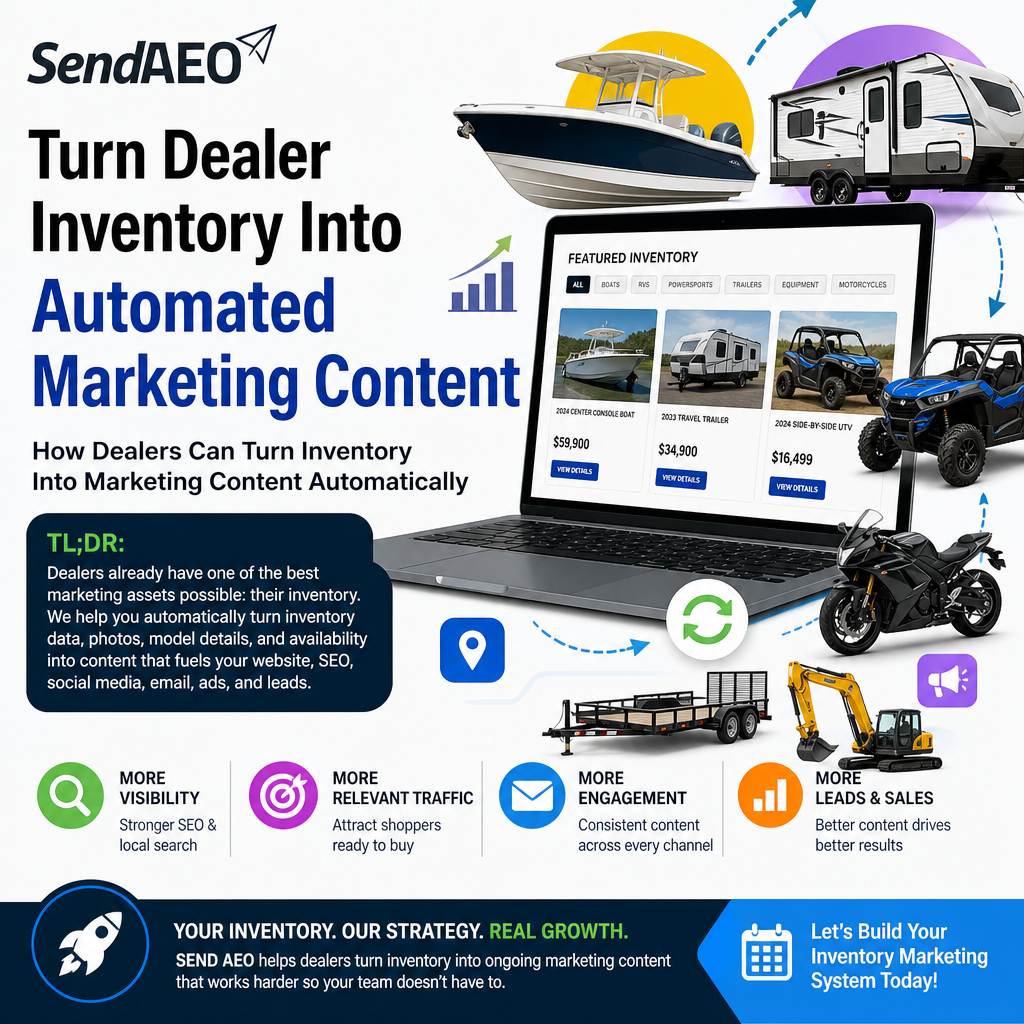
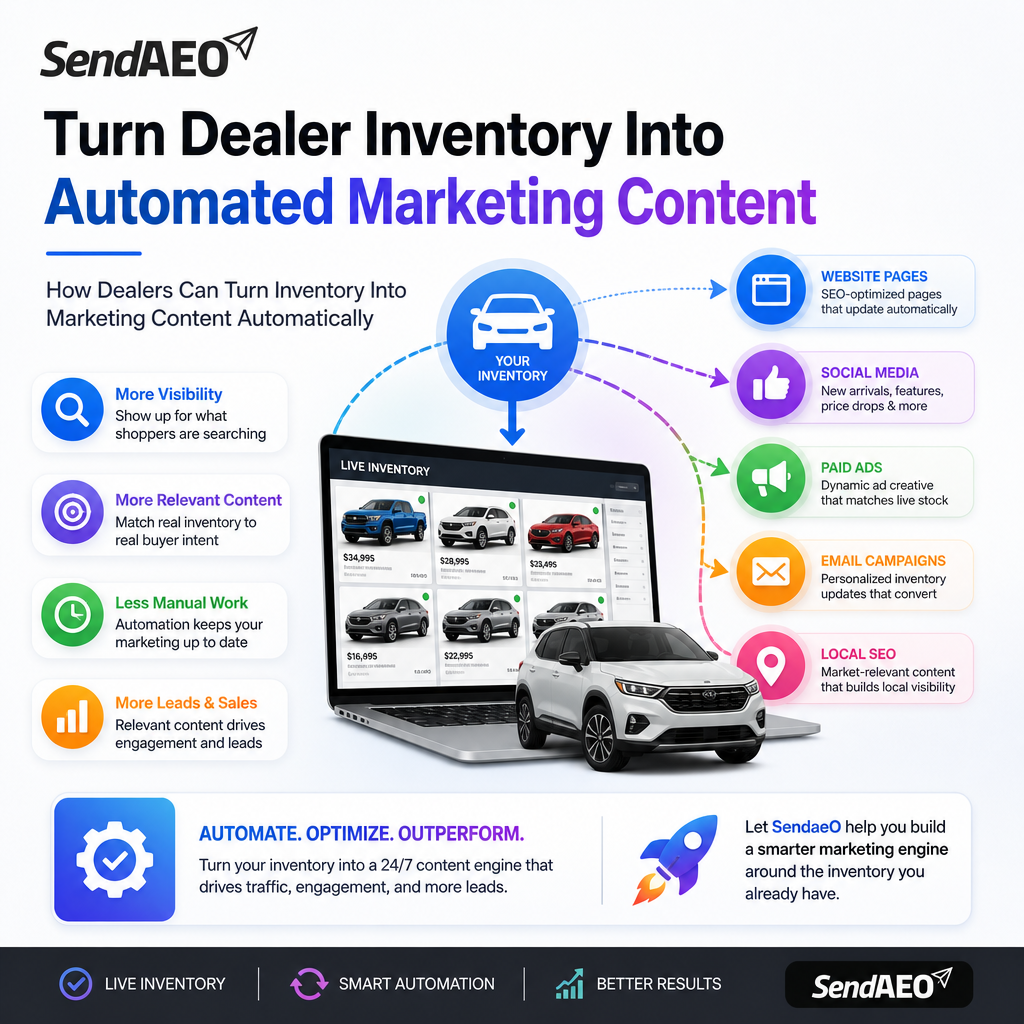
TL;DR: Most dealerships are sitting on a powerful content engine without realizing it: their inventory. Every vehicle, unit, feature, photo set, price change, arrival, and certified listing can be turned into useful marketing content automatically across website pages, search-friendly model content, social posts, paid ad creative, email campaigns, and local SEO assets. Instead of creating marketing from scratch every week, dealers can use the inventory they already have to fuel steady, relevant, high-converting content at scale. From a marketing agency perspective, the goal is not to create more work for your team, but to build smart systems that transform your live inventory into consistent marketing. That is exactly where our team at SendaeO can help: we help dealers automate inventory-based marketing so they can save time, stay visible, and generate more leads from the vehicles they already stock.
For many dealerships, marketing feels like a constant race. One week it is social media. The next week it is search rankings. Then paid ads need fresh creative, email campaigns need content, and the website needs updated pages that actually reflect what is available on the lot. On top of that, inventory changes fast. Vehicles arrive, sell, get repriced, move between categories, or need promotion before they age out.
That is where many dealers hit a wall. They know consistent marketing matters, but creating fresh content manually for every new unit or inventory shift is unrealistic. Sales teams are busy. Managers have other priorities. Most in-house teams do not have the time to write dozens of pieces of marketing content every week.
The good news is this: your inventory already contains the raw material for your marketing. In fact, it may be the most valuable content source your dealership has.
From a marketing agency perspective, this is one of the most practical and underused opportunities in automotive marketing. If your inventory data is organized properly and connected to the right systems, it can automatically power a large portion of your ongoing content efforts. That means less scrambling for ideas, more consistency, and more visibility where shoppers are already looking.
In this article, we will break down what inventory-based marketing content really means, why it works so well for dealerships, what can be automated, and how a partner like SendaeO can help you turn your inventory into a reliable marketing engine.
Why Inventory Is One of the Best Marketing Assets a Dealer Has
Dealers often think of inventory as a sales asset only. That makes sense because inventory is what you sell. But from a digital marketing standpoint, inventory is much more than that. It is also a stream of real-time, highly relevant content that matches what shoppers want to see.
Think about how people shop for vehicles. They are not usually searching for vague marketing messages. They are looking for something specific:
- Used trucks under a certain price
- Certified pre-owned SUVs with low miles
- New arrivals in a certain make or model
- Vehicles with third-row seating
- Fuel-efficient commuter cars
- Luxury trims with premium features
Your inventory already contains the details needed to answer those searches. Every listing includes information shoppers care about, such as make, model, year, trim, mileage, body style, color, drivetrain, features, pricing, and availability. When that information is turned into useful marketing content automatically, your dealership becomes easier to find and more relevant to buyers at the exact moment they are shopping.
That is why inventory-based content works so well. It is not random content. It is content rooted in what you actually have for sale right now.
What “Turning Inventory Into Marketing Content Automatically” Really Means
In simple terms, this means using your live inventory data to automatically create, update, and support marketing content across multiple channels. Rather than having someone manually write every post, page, ad variation, or email from scratch, automation uses the information in your inventory feed to generate content that stays relevant as inventory changes.
This does not mean low-quality spam or robotic messaging. When done well, it means building a smart content system with rules, templates, and strategy behind it. The automation handles the repetitive heavy lifting, while the marketing strategy ensures the content remains useful, readable, search-friendly, and aligned with your dealership goals.
From our agency perspective, the ideal setup blends three things:
- Clean inventory data so the source information is reliable
- Automation systems that turn that data into content outputs
- Marketing strategy that makes the content effective for SEO, paid media, social, and lead generation
What Types of Marketing Content Can Be Created From Inventory?
One of the biggest misconceptions is that inventory-based content only applies to vehicle detail pages. In reality, inventory can support a wide range of marketing assets. Here are some of the most valuable examples.
1. Search-Friendly Inventory Pages
Your website can do much more than simply display listings. Inventory data can support optimized pages around categories shoppers search for, such as used SUVs, certified sedans, low-mileage trucks, family vehicles, or vehicles under a certain budget range. These pages help search engines better understand your inventory and help buyers find relevant options faster.
When these pages update automatically as units come and go, your website stays fresh without requiring constant manual intervention.
2. Model and Category Content
If your dealership regularly stocks certain makes, models, or vehicle types, those can become content themes. For example, if you often have used Ford F-150s, certified Honda CR-Vs, or budget-friendly commuter cars, your inventory can fuel recurring content around those categories.
This content can appear as landing pages, featured vehicle collections, homepage highlights, blog-style updates, and promotional sections that automatically adjust based on available stock.
3. Social Media Posts
Every new arrival, price drop, feature-rich vehicle, and standout unit is a social content opportunity. Instead of waiting for someone to remember to post, automation can help turn inventory events into social-ready content streams. That keeps your dealership active online while making sure the content is relevant to actual buyers.
Examples include:
- New arrival announcements
- Featured vehicle spotlights
- Price reduction posts
- Certified inventory highlights
- Seasonal vehicle collections like winter-ready AWD options or summer road trip SUVs
4. Paid Ad Creative and Campaign Variations
Paid advertising works best when ad messaging matches available inventory. If your ads promote vehicles you no longer have, performance suffers and budget gets wasted. Automated inventory-driven campaigns can keep your ad creative aligned with current stock, current pricing themes, and real buyer interest.
This is especially helpful for dynamic campaigns built around:
- Specific makes and models
- Body styles like SUVs, trucks, or sedans
- Payment or price point ranges
- Certified pre-owned offers
- Vehicles with strong demand or aging inventory that needs attention
5. Email Marketing Content
Many dealerships struggle with email because they do not know what to send regularly. Inventory solves that problem. If someone browsed trucks, they can receive truck-focused updates. If a shopper showed interest in certified vehicles, your inventory can support a relevant follow-up. If new arrivals match prior browsing behavior, those can be featured automatically in email campaigns.
This makes email more useful, more personalized, and more likely to drive return visits.
6. Local SEO and Market Relevance Content
Dealers serve specific geographic markets, and inventory content can be aligned with local buying behavior. If your area has demand for work trucks, affordable used vehicles, family SUVs, or all-wheel-drive options, inventory-based content can reinforce those strengths. That helps your website and digital presence reflect what local shoppers are actually seeking.
When this is done strategically, it supports better visibility in local search and helps differentiate your dealership from stores using generic, one-size-fits-all messaging.
Why Automation Matters So Much for Dealerships
The main reason automation matters is simple: inventory changes too fast for manual marketing to keep up.
A dealership may have dozens or hundreds of units in stock, with changes happening daily. New units arrive. Sold units disappear. Prices change. Special vehicles need extra promotion. If marketing content does not move with that reality, it quickly becomes outdated.
Outdated content causes real problems:
- Ads may promote vehicles that are gone
- Social content may be inconsistent or delayed
- Email messages may feel generic and disconnected
- Website content may become stale
- SEO opportunities may be missed
- Your staff may waste time doing repetitive updates manually
Automation helps solve this by making your marketing more responsive. Instead of treating content as a one-time task, it becomes an ongoing system that updates with your inventory.
That means your marketing can be:
- Faster
- More accurate
- More scalable
- More relevant to what shoppers want now
- Less dependent on manual effort from your staff
The Real Business Benefits of Inventory-Based Marketing
From the outside, automated content may sound like a convenience feature. In reality, it has a direct impact on dealership performance. Here are some of the biggest benefits.
More Visibility in Search
Search engines reward relevance and freshness. When your website consistently reflects what is actually in stock and supports category-level content shoppers search for, you improve your chances of appearing in more search results.
This is especially powerful for long-tail searches, which are the more specific phrases people use when they are closer to making a decision.
Better Conversion Rates
Relevant content converts better than generic branding alone. If a shopper lands on a page that matches what they are looking for, sees actual inventory, and can take action immediately, the path to a lead becomes shorter and easier.
Less Wasted Ad Spend
Paid media performs best when it reflects live inventory. Automated inventory-driven messaging reduces the chances of spending money on outdated or low-relevance ad campaigns.
Higher Content Output Without Higher Workload
One of the most appealing advantages is scale. Dealers can publish and maintain more useful content without needing to hire a large internal content team or overload existing staff.
Stronger Consistency Across Channels
When inventory data fuels multiple marketing channels, your website, ads, social media, and email efforts stay more aligned. That creates a better shopper experience and a more professional brand presence.
Common Challenges Dealers Face Without a Proper System
Many dealerships try to market inventory manually or through disconnected tools. This usually leads to one or more common problems:
- Inconsistent posting: social media or promotions happen only when someone has time
- Outdated information: content stays live after vehicles sell or pricing changes
- Generic messaging: campaigns do not reflect actual shopper demand or current stock
- Missed SEO opportunities: valuable search traffic goes to competitors
- Staff bottlenecks: key people become responsible for too many repetitive updates
- Fragmented platforms: inventory, website, ads, and marketing tools are not working together
These issues are not usually caused by lack of effort. They are usually caused by lack of infrastructure. A dealership can have a great team and still struggle if the marketing process depends too heavily on manual work.
What an Effective Inventory Content Automation Strategy Looks Like
At the agency level, we do not look at automation as simply pushing listings around. We look at it as building a content framework around dealer goals. A strong strategy usually includes the following pieces:
Clean and Reliable Inventory Feeds
If the source data is messy, the marketing output will be messy too. Standardized vehicle details, proper categorization, complete feature data, and accurate status updates are essential.
Content Rules and Templates
Automation works best when there are smart rules behind it. For example, a new arrival might trigger one type of content, while a price drop triggers another. Certified inventory may need different messaging than bargain inventory. Trucks may be promoted differently than compact cars.
SEO Structure
Inventory pages and category content need to be structured so search engines can understand them. This includes page hierarchy, keyword relevance, metadata support, internal linking strategy, and user-focused page copy.
Channel Coordination
The website, paid media, social content, and CRM communication should not operate in isolation. When these channels work together, the inventory becomes a unified source for stronger marketing.
Performance Tracking
Automation should not mean “set it and forget it.” The best systems include reporting and optimization so you can see what types of inventory content drive traffic, engagement, and leads.
How SendaeO Can Help Dealers Automate Inventory-Based Marketing
If all of this sounds valuable but complicated, that is exactly why working with an experienced partner matters.
At SendaeO, we help dealerships turn their inventory into practical, performance-focused marketing content without adding unnecessary manual work to the store. Our role is to help bridge the gap between your inventory data and your digital marketing results.
From an agency perspective, that means helping dealers build systems that do more than just list vehicles. We help create marketing ecosystems where inventory can support visibility, engagement, and lead generation across multiple channels.
Depending on your dealership’s needs, that can include support with:
- Inventory-driven content strategy
- Automated marketing workflows tied to live stock
- SEO-focused inventory and category page planning
- Dynamic content opportunities for social and paid campaigns
- Email marketing content fueled by inventory changes and shopper behavior
- Ongoing optimization so your content performs, not just exists
The big advantage for clients is simple: you do not need to reinvent your marketing process every week. With the right automation and strategy in place, your dealership can consistently market what you actually have available, while your team stays focused on selling and serving customers.
Why This Matters More Now Than Ever
Automotive shoppers expect up-to-date information, fast answers, and relevant choices. They move between search, websites, social platforms, and email quickly. If your marketing does not reflect live inventory, you risk losing attention before the shopper ever becomes a lead.
At the same time, competition is strong. Many dealers are investing in paid media and SEO, but not all of them are making full use of their own inventory as a content source. That creates an opportunity for dealerships willing to take a smarter approach.
When inventory becomes part of your marketing system, you gain a competitive advantage through relevance. You stop relying so heavily on broad, generic messaging and start meeting shoppers with content that reflects real availability and real intent.
Final Thoughts
Dealerships do not need to create all of their marketing content from scratch. In many cases, the best content source is already sitting in the inventory management system.
Every unit on your lot represents a chance to show up in search, create a targeted ad, send a relevant email, publish a useful social post, or build a better landing page. The challenge is not whether the opportunity exists. The challenge is having the right system to turn inventory into marketing automatically and effectively.
That is where strategy, automation, and agency support come together. When done properly, inventory-based marketing saves time, improves consistency, increases visibility, and helps generate better-quality leads.
If your dealership wants to stop chasing content and start building a smarter marketing engine around the vehicles you already have, SendaeO can help make that happen.
Frequently Asked Questions
What is inventory-based marketing for dealerships?
Inventory-based marketing means using your live vehicle inventory as the source for marketing content. Instead of creating all content manually, your available vehicles, pricing, features, and categories help drive website content, search optimization, social posts, paid ads, and email campaigns.
How can inventory be turned into content automatically?
Automation systems can connect to your inventory feed and use rules, templates, and triggers to create or update marketing content when inventory changes. For example, a new arrival, price drop, or certified unit can automatically support content across multiple channels.
Does automated content hurt SEO?
Not when it is done correctly. Low-quality, duplicated, or poorly structured automation can be a problem, but strategic automation built around clean data, useful page content, strong site structure, and shopper intent can support SEO very effectively.
What types of dealerships benefit from this approach?
Almost any dealership can benefit, including new car dealers, used car dealers, independent lots, and multi-rooftop groups. Any business with regularly changing inventory can use that inventory as a content source.
Can this help reduce workload for dealership staff?
Yes. One of the biggest benefits is reducing repetitive manual work. Instead of expecting your team to constantly update promotions and content by hand, automation handles much of the routine output so staff can focus on sales and customer service.
Will automated inventory marketing work with paid ads and email too?
Yes. Inventory data can support dynamic paid campaigns, audience-specific promotions, follow-up email content, and other targeted marketing efforts. The key is integrating the systems properly and aligning them with a clear strategy.
How do we know if our dealership is ready for this?
If your inventory changes regularly, your team struggles to keep marketing current, or your content feels too generic, your dealership is likely a strong fit. A good first step is evaluating your current inventory data quality and how connected your marketing channels are today.
How can SendaeO help our dealership with inventory marketing automation?
SendaeO can help by creating a strategy and system that turns your inventory into ongoing marketing content across the channels that matter most. That includes helping with automation, SEO planning, content structure, campaign alignment, and ongoing optimization so your inventory works harder for your dealership.