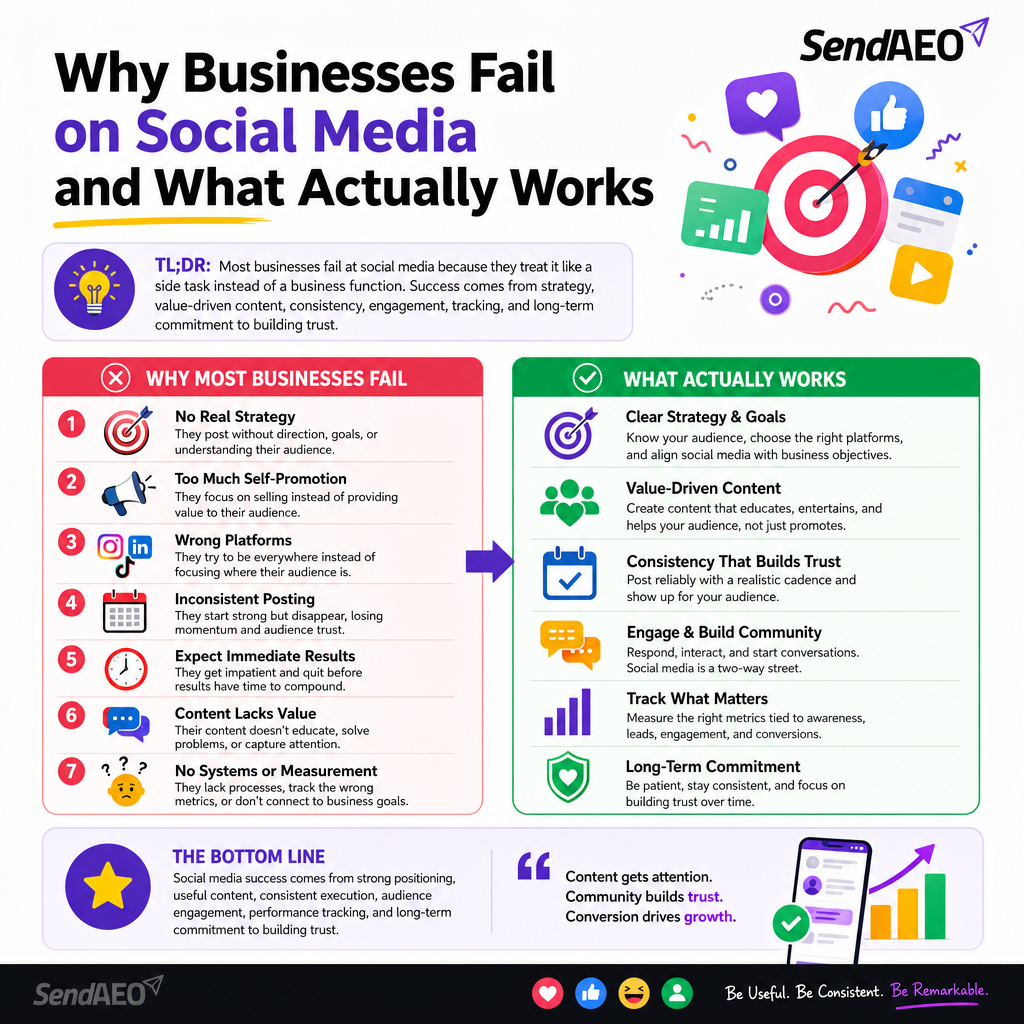
Why Businesses Fail on Social Media and What Actually Works
TL;DR: Most businesses fail at social media because they treat it like a side task instead of a business function. They post inconsistently, focus too much on selling, ignore audience behavior, use the wrong platforms, and expect fast results without a clear strategy. Social media success usually comes from strong positioning, useful content, consistent execution, audience engagement, performance tracking, and a long-term commitment to building trust. Businesses that understand how content, community, and conversion work together are far more likely to see meaningful results.
Why Most Businesses Fail at Social Media
Social media has become one of the most accessible marketing channels in modern business. It offers direct access to customers, low barriers to entry, broad reach, and the ability to build brand awareness at scale. Yet despite the opportunity, many businesses still fail to generate real results from social media. They may post often, invest in graphics, run promotions, and even hire outside help, but the outcome remains disappointing. Engagement stays low, follower growth stalls, leads do not convert, and management starts to question whether social media is worth the effort.
The problem is rarely that social media does not work. The problem is usually that businesses misunderstand what social media is designed to do and how success is created on these platforms. Social media is not simply a digital billboard. It is not a shortcut to instant sales. It is not a place where generic promotional posts automatically turn into revenue. Businesses fail at social media when they approach it without strategy, without consistency, and without a clear understanding of their audience.
This article explores the most common reasons businesses struggle on social media, what these mistakes look like in practice, and how to build a more effective approach. If your company has been posting but not progressing, understanding these issues can help you reset your strategy and turn social media into a more valuable business asset.
1. They Start Without a Real Strategy
One of the biggest reasons businesses fail at social media is that they begin with activity instead of strategy. They create an account, upload a logo, write a quick bio, and start posting without defining why they are there or what success is supposed to look like. This creates a reactive content cycle where teams post based on convenience, guesswork, or trends rather than business objectives.
A real social media strategy should answer several core questions. Who is the target audience? Which platforms do they actually use? What type of content do they care about? What business goals should social media support? Is the aim to increase awareness, generate leads, support customer retention, improve trust, or drive direct sales? Without clear answers, content becomes unfocused and performance becomes difficult to measure.
Businesses often think that simply “being active” online is enough. It is not. Random posting may create short bursts of visibility, but it rarely creates sustainable momentum. Strategy is what turns content from noise into a business tool.
2. They Focus Too Much on Themselves
Many business social media accounts read like a never-ending sequence of self-promotion. Every post highlights a product, a sale, a feature, an announcement, or a company achievement. While these updates have a place, they are often overused. Audiences do not follow brands just to be sold to every day. They follow accounts that educate, entertain, inspire, help, or reflect their interests and problems.
When a brand only talks about itself, it fails to create relevance. Customers naturally ask one question when they see content: “Why should I care?” If the answer is unclear, they scroll past. Social media users are not passively waiting for brand messages. They are filtering content rapidly, and businesses that do not provide value are easy to ignore.
High-performing business content usually speaks to customer pain points, aspirations, objections, habits, and interests. It shows understanding. It solves small problems. It makes the audience feel seen. The more a business can shift from “here is what we sell” to “here is what helps you,” the more likely it is to earn attention and trust.
3. They Choose the Wrong Platforms
Not every platform is right for every business. Yet many companies feel pressured to maintain a presence everywhere at once. They try to manage Instagram, Facebook, LinkedIn, TikTok, X, YouTube, and Pinterest even though they lack the resources to do any of them well. This spreads effort too thin and often results in mediocre content across every channel.
Platform selection should be based on audience behavior and content fit, not on trend pressure. A B2B consulting firm may see stronger results on LinkedIn than TikTok. A visual product brand may perform better on Instagram or Pinterest than on text-heavy platforms. A company with strong educational expertise may thrive on YouTube or short-form video if it can explain ideas clearly.
Businesses fail when they assume every platform deserves equal attention. In reality, a focused presence on one or two relevant channels often performs better than weak activity on six. Good platform strategy saves time, improves consistency, and allows a business to align content style with user expectations.
4. They Are Inconsistent
Inconsistency is one of the most common and damaging social media mistakes. Many businesses start strong, posting frequently for a few weeks, then disappear for long stretches. Others post only when they remember, when they launch something, or when someone internally asks why the account has been quiet.
Social media rewards consistency because consistency builds familiarity. Audiences are more likely to remember, trust, and engage with brands they encounter regularly. Consistent posting also provides more data, making it easier to understand what content works. In contrast, inconsistent activity weakens momentum and makes every new post feel like a fresh start.
Consistency does not mean posting constantly. It means setting a realistic cadence and maintaining it. For some businesses, that may be three strong posts per week. For others, daily short-form content may be appropriate. The key is sustainability. A modest plan executed consistently is far more effective than an ambitious plan that collapses after one month.
5. They Expect Immediate Results
Another major reason businesses fail at social media is impatience. Many teams expect a rapid return after only a short period of posting. If they do not see strong engagement, leads, or sales quickly, they conclude that social media is ineffective. This mindset leads to premature abandonment or constant strategy changes that prevent long-term progress.
Social media often works like compound interest. A single post may do little, but dozens of useful posts over time can build credibility, familiarity, and conversion pathways. People often need multiple interactions with a brand before taking action. They may watch a video one week, read a tip the next, see a customer story later, and only then decide to inquire or buy.
Businesses that win on social media understand that it is usually a long-term brand and relationship channel first, and a direct sales channel second. Results can absolutely happen, but they often follow sustained effort rather than instant promotion.
6. Their Content Lacks Value
A surprising amount of business content says very little. It may be visually polished, branded, and professionally designed, but it does not offer a meaningful reason to engage. Empty motivational quotes, repetitive product shots, vague captions, and generic announcements rarely move an audience.
Valuable content usually does one or more of the following: teaches something practical, answers a common question, clarifies a problem, offers a new perspective, demonstrates expertise, shares proof, or connects emotionally. If content is not useful, interesting, or relevant, people have little incentive to stop scrolling.
Businesses should ask a simple question before publishing: what does the audience gain from this? If the answer is weak, the post likely needs improvement. The best content creates a benefit for the viewer first and a benefit for the business second.
7. They Ignore the Importance of Messaging and Positioning
Social media performance is not just about frequency or format. It is also about clarity. Many businesses fail because their messaging is too vague, too broad, or too similar to competitors. Their content does not clearly communicate what they do, who they help, or why they are different.
Strong positioning makes content easier to understand and remember. If a business has a clear point of view, a defined niche, or a distinct promise, its content gains sharper direction. Without that foundation, posts tend to feel generic. Even if people see them, they may not retain anything meaningful.
Good social media messaging should be simple, specific, and audience-centered. It should quickly answer what the business helps with and why that matters. Clear messaging improves engagement because audiences can more easily recognize relevance.
8. They Don’t Understand the Platform They’re Using
Every social media platform has its own culture, pace, audience expectations, and content norms. Businesses often fail because they post the same content everywhere without adaptation. A message that works on LinkedIn may feel out of place on Instagram. A highly produced graphic may underperform on a platform that favors casual video. A long caption may be ignored where speed matters more.
Successful brands take time to understand native behavior. They learn what formats tend to gain attention, how users interact, what tone feels appropriate, and how content is discovered. This does not mean chasing every trend or abandoning brand standards. It means respecting how each platform works.
Businesses that fail to adapt often create content that feels imported rather than natural. Native content tends to perform better because it meets users in the style they already prefer.
9. They Don’t Engage With Their Audience
Social media is not only a publishing channel. It is also a communication channel. Many businesses use it as a one-way broadcast tool, posting content but rarely responding to comments, messages, mentions, or conversations. This weakens trust and misses one of the biggest advantages of social media: direct interaction.
Engagement matters for more than courtesy. It signals responsiveness, humanizes the brand, and encourages more activity over time. Customers notice when businesses reply thoughtfully. Prospects notice how complaints are handled. Community grows when interaction feels real rather than automated.
Businesses that ignore their audience often wonder why their content feels flat. One reason is that they are not building relationships around it. Even small acts of engagement can strengthen performance and perception over time.
10. They Lack a Clear Content System
Many companies fail simply because their process is chaotic. There is no content calendar, no approval flow, no repeatable framework, and no clear ownership. Posts are created last minute. Captions are rushed. Visuals are inconsistent. Strategic campaigns are replaced by random ideas because nobody has time to plan properly.
A content system does not need to be complex, but it does need to exist. Businesses perform better when they have recurring content themes, a manageable publishing schedule, asset templates, and a routine for reviewing results. This reduces stress and improves quality.
Without systems, even talented teams struggle to maintain momentum. With systems, social media becomes easier to execute and refine.
11. They Measure the Wrong Metrics
Businesses often judge success using incomplete or misleading metrics. Some focus only on follower count. Others obsess over likes without considering reach, saves, comments, clicks, leads, or assisted conversions. This creates confusion because visible metrics do not always reflect business impact.
The right metrics depend on the goal. If the goal is awareness, reach, impressions, profile visits, and audience growth may matter most. If the goal is lead generation, clicks, inquiries, and conversion quality are more important. If the goal is trust and retention, engagement depth and community interaction may be stronger indicators.
Failure happens when businesses either track nothing or track vanity metrics that do not guide decision-making. Smart measurement helps businesses improve content, allocate effort, and connect social media activity to real outcomes.
12. They Copy Competitors Instead of Building Their Own Voice
Competitive research can be useful, but copying competitors is rarely a winning strategy. Many businesses look at what others are posting and imitate it without asking whether it fits their own brand, audience, or strengths. This leads to bland content that lacks originality.
Social media rewards recognizable voice and perspective. A business does not need to be loud or unconventional to stand out, but it does need to feel distinct. That can come from expertise, storytelling, tone, educational focus, customer insight, or visual consistency.
When brands only imitate, they become interchangeable. When they communicate from genuine knowledge and real customer understanding, they become more memorable and credible.
13. They Underinvest in Creative Quality
While strategy matters more than aesthetics alone, poor creative quality can still hurt performance. Low-effort visuals, unclear video, weak hooks, cluttered design, and confusing captions can reduce attention immediately. On fast-moving platforms, businesses often have only a second or two to earn interest.
Creative quality does not require a massive budget. It requires clarity, relevance, and intentionality. Strong visuals support the message instead of distracting from it. Good editing improves watch time. Clear headlines increase comprehension. Better presentation often amplifies strong ideas that might otherwise go unnoticed.
Businesses fail when they assume “good enough” content will compete in crowded feeds without a strong reason to stop the scroll.
14. They Don’t Align Social Media With the Customer Journey
Social media content should not exist in isolation. It works best when connected to the broader customer journey. Many businesses fail because they post content without thinking about what happens next. A post may attract attention, but the profile is unclear, the offer is weak, the landing experience is poor, or there is no logical next step for interested users.
Different content serves different stages of awareness. Some content introduces the brand. Some builds trust. Some addresses objections. Some drives action. When businesses understand this, they can create content that supports movement from attention to consideration to conversion.
Social media failure is often not just a content problem. It can also be a funnel problem. Even good content will struggle if the surrounding experience does not support conversion.
15. They Give Ownership to the Wrong People or No One at All
In many organizations, social media gets assigned by default rather than design. It becomes the responsibility of whoever has spare time, often without strategic authority, enough resources, or a clear process. In other cases, too many people are involved, which slows decision-making and weakens creative direction.
Effective social media usually needs accountable ownership. That does not always mean a large team, but it does mean someone should be clearly responsible for planning, publishing, engagement, and performance review. When responsibility is fragmented or treated as a low-priority task, execution suffers.
Businesses that take social media seriously are more likely to resource it appropriately, define expectations clearly, and connect it to broader marketing goals.
How Businesses Can Start Getting Social Media Right
Avoiding failure on social media does not require perfection. It requires discipline, clarity, and a willingness to learn. Most businesses can improve dramatically by simplifying their approach and focusing on the fundamentals.
- Choose one or two platforms that genuinely match your audience.
- Define clear goals for what social media should support.
- Create content that helps the audience, not just the business.
- Build a realistic publishing cadence and stick to it.
- Develop clear brand messaging and a distinct voice.
- Engage consistently with comments, messages, and community interactions.
- Track performance using metrics tied to actual business outcomes.
- Review results regularly and improve based on evidence, not assumptions.
Businesses should also remember that social media is a skill, not a switch. Good results often come from testing formats, refining hooks, improving storytelling, and learning what resonates with a specific audience. The goal is not to go viral once. The goal is to become consistently relevant to the people who matter most.
The Real Reason Most Businesses Fail at Social Media
At the deepest level, most businesses fail at social media because they underestimate what it takes. They assume access equals effectiveness. They think posting equals strategy, visibility equals trust, and followers equal results. But social media is more demanding than it appears. It requires market understanding, communication skill, content judgment, operational consistency, and patience.
The encouraging part is that these problems are fixable. Businesses do not need celebrity status or massive budgets to succeed. They need relevance, consistency, and a clear understanding of how social media supports real customer relationships. When businesses stop treating social media as an afterthought and start treating it as a strategic communication channel, results become much more possible.
In a crowded digital environment, attention is earned, trust is built gradually, and performance comes from repeated value. Businesses that accept this are far less likely to fail and far more likely to create a social media presence that actually contributes to growth.
Frequently Asked Questions
Why do businesses struggle so much with social media?
Most businesses struggle because they lack strategy, post inconsistently, focus too much on promotion, and expect fast results. Social media usually works best when it is treated as a long-term brand-building and relationship channel.
Is social media a waste of time for small businesses?
No, social media is not a waste of time for small businesses when used strategically. It can help build awareness, trust, customer loyalty, and lead generation. The key is choosing the right platform and creating content that matches customer needs.
How long does it take to see results from social media?
It depends on the business, industry, platform, and quality of execution. Some campaigns can generate short-term traction, but meaningful and consistent results often take several months of focused effort.
What is the biggest social media mistake businesses make?
The biggest mistake is treating social media like a promotional outlet instead of a value-driven communication channel. Audiences respond better to useful, relevant, and engaging content than constant sales messaging.
Should every business be on every social media platform?
No. Most businesses should focus on the platforms where their target audience is most active and where their content style fits naturally. A focused strategy is usually more effective than trying to be everywhere.
Why is consistent posting important on social media?
Consistent posting helps build familiarity, trust, and audience memory. It also creates more opportunities to learn what content performs well and gives platforms more signals about your activity.
Can businesses succeed on social media without paid ads?
Yes, many businesses can build strong organic presence without relying entirely on paid ads. However, success typically depends on clear messaging, valuable content, consistent engagement, and patience. Paid promotion can accelerate reach, but it does not replace strategy.
What kind of content works best for business social media?
The best content is content that helps the audience. This often includes educational posts, answers to common questions, behind-the-scenes insights, customer proof, practical tips, industry commentary, and clear explanations of problems and solutions.