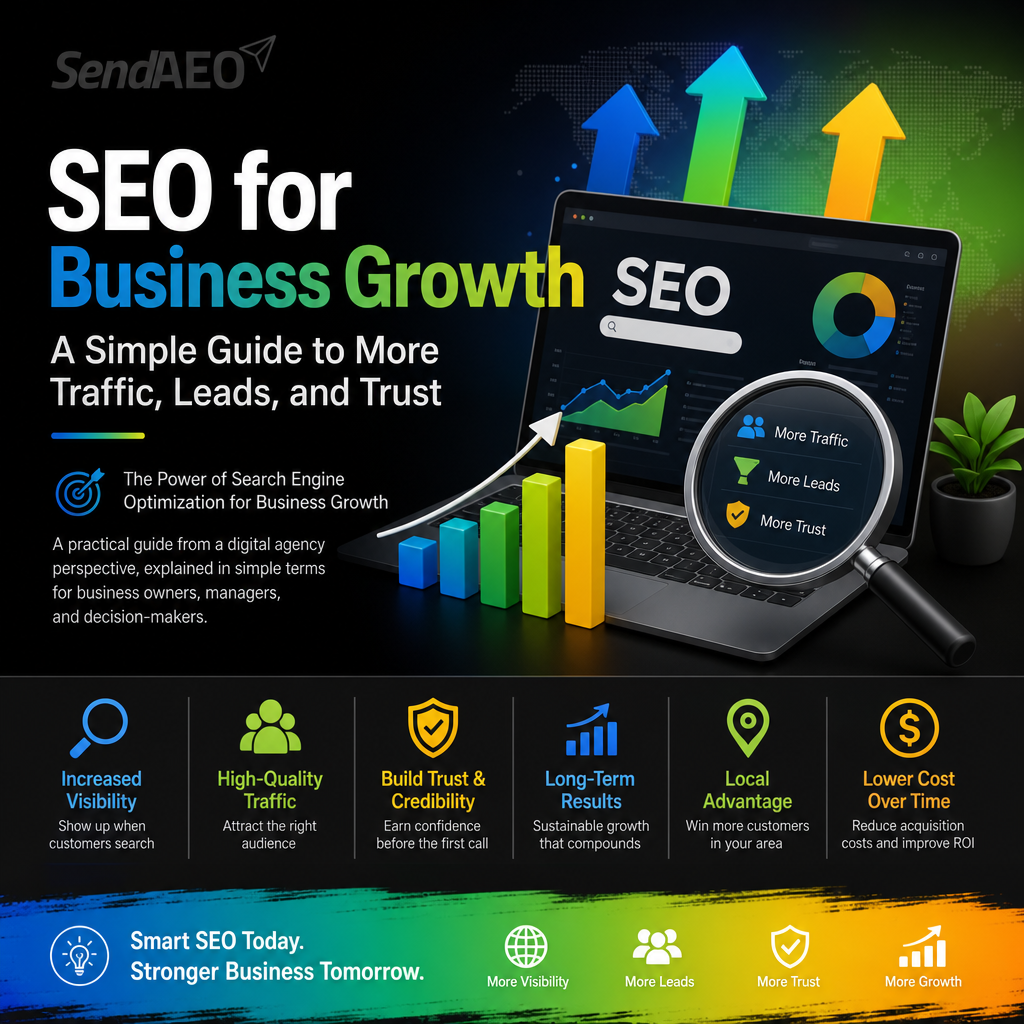
SEO for Business Growth A Simple Guide to More Traffic Leads and Trust
The Power of Search Engine Optimization for Business Growth
A practical guide from a digital agency perspective, explained in simple terms for business owners, managers, and decision-makers.
TL;DR
Search engine optimization, or SEO, helps your business show up when people search online for the products or services you offer. From a digital agency perspective, SEO is one of the most valuable long-term marketing investments because it improves visibility, brings in qualified traffic, builds trust, supports your website experience, and can lower customer acquisition costs over time. Unlike short-term advertising that stops when the budget runs out, strong SEO creates a foundation for ongoing growth. When done properly, it connects your business with people who are already looking for answers, solutions, or providers like you.
For many business owners, SEO can feel technical, confusing, and full of jargon. Terms like rankings, keywords, backlinks, indexing, and technical audits can make it seem more complicated than it really is. At its core, however, SEO is simple. It is the process of helping search engines understand your website and helping the right people find your business at the right time.
From the perspective of a digital agency, SEO is not just about getting a website to rank higher on Google. It is about creating real business growth. That means more qualified leads, more phone calls, more quote requests, more store visits, more brand awareness, and more revenue opportunities. A strong SEO strategy is not built around tricks or shortcuts. It is built around understanding your audience, improving your website, and building authority in your market over time.
If you have ever wondered whether SEO is worth the investment, how it works, or why so many businesses prioritize it, this guide will break it down in plain English.
What Is SEO in Simple Terms?
SEO stands for search engine optimization. It is the work done on and around your website to help it appear more prominently in search engine results when people look for topics related to your business.
For example, if you own a roofing company, you want your business to appear when someone searches for phrases like “roof repair near me” or “best roofing contractor.” If you run a law firm, you want visibility when potential clients search for the type of legal help you provide. If you sell products online, you want your category pages and product pages to show up when people are ready to compare options and buy.
SEO helps make that happen by improving the content, structure, speed, credibility, and relevance of your website. Search engines want to show users the most useful and trustworthy results. SEO is how your business proves it belongs in that conversation.
Why SEO Matters for Business Growth
A website alone does not guarantee visibility. Many businesses invest in beautiful websites, but then wonder why traffic is low or why leads are inconsistent. The answer is often simple: if your ideal customers cannot find you in search results, your website is missing one of its most important jobs.
SEO matters because it puts your business in front of people who already have intent. These are not random viewers scrolling casually through content. They are actively searching for information, services, solutions, or products. That intent makes search traffic extremely valuable.
From an agency standpoint, SEO supports growth in several important ways:
1. It increases visibility where customers are already looking
People use search engines every day to solve problems and make decisions. If your business appears consistently for the right searches, you create more opportunities to be chosen.
2. It brings in higher-quality traffic
Not all website traffic is equal. SEO focuses on attracting visitors who are relevant to your business. That often means better conversion potential compared to broader awareness campaigns.
3. It builds trust and credibility
People tend to trust businesses that appear prominently in search results. A well-optimized website with useful content and strong reviews can create confidence before a prospect even contacts you.
4. It supports long-term marketing efficiency
Paid advertising can generate results quickly, but those results often stop as soon as spending stops. SEO usually takes longer to build, but it can continue generating traffic and leads over time.
5. It improves the overall quality of your website
Good SEO encourages better site structure, stronger messaging, faster load times, cleaner navigation, and a more helpful user experience. That benefits both search engines and real people.
How a Digital Agency Looks at SEO
When clients first ask about SEO, they often focus on one question: “Can you get us to number one on Google?” While rankings do matter, an experienced agency looks deeper than that. The real question is not just where you rank. The real question is whether SEO is helping your business grow.
A digital agency typically views SEO through a business lens. That means looking at performance indicators such as qualified traffic, lead volume, lead quality, conversion rate, geographic visibility, revenue opportunities, and return on investment. Strong SEO should connect directly to business outcomes, not just vanity metrics.
An agency also understands that SEO is rarely one isolated tactic. It sits at the intersection of content strategy, web development, user experience, brand messaging, analytics, and conversion optimization. In other words, SEO works best when it is integrated into your broader digital marketing strategy.
The Main Parts of SEO
SEO is often easier to understand when broken into its main parts. While every campaign is different, most SEO strategies involve the following core areas:
On-Page SEO
This refers to the content and elements on your website pages. It includes page titles, headings, written copy, internal linking, image optimization, and how clearly each page aligns with a search topic. The goal is to make every important page relevant, useful, and easy for both users and search engines to understand.
Technical SEO
This covers the behind-the-scenes health of your website. Technical SEO helps search engines crawl and index your pages properly. It also includes factors such as site speed, mobile friendliness, security, structured data, broken links, duplicate content issues, and overall site architecture.
Content SEO
Content plays a major role in SEO because it answers the questions people are searching for. Blog posts, service pages, location pages, category pages, guides, and FAQs can all help your business gain visibility. The key is not simply publishing more content, but publishing content that is helpful, targeted, and aligned with user intent.
Off-Page SEO
Off-page SEO focuses on signals from outside your website that build trust and authority. This often includes backlinks from reputable websites, brand mentions, digital PR, and a strong online presence. Search engines view these signals as indicators that your business is credible and relevant.
Local SEO
For businesses that serve specific cities or regions, local SEO is especially important. This helps your business appear in local search results, map listings, and “near me” searches. Local SEO involves accurate business information, location-focused pages, reviews, local citations, and optimization of your business profile.
SEO Is Not Magic, But It Is Powerful
One of the most important things a digital agency can do is set realistic expectations. SEO is powerful, but it is not instant. It usually takes time to research your market, improve your website, publish helpful content, build authority, and earn stronger search visibility.
That said, the long-term value can be substantial. Think of SEO like building a strong reputation in a busy marketplace. It does not happen overnight, but once your business becomes more visible and trusted, the momentum can lead to consistent growth.
Businesses that commit to SEO often find that the compounding effect is what makes it so valuable. Over time, optimized pages can continue attracting visitors month after month. Content can rank for multiple search terms. Improved authority can help your whole site perform better. The result is a marketing asset that becomes more valuable the longer it is developed properly.
What Clients Often Get Wrong About SEO
From an agency perspective, there are a few common misunderstandings that can get in the way of good results. Understanding these can help set a better foundation for success.
“SEO is just about keywords.”
Keywords matter, but modern SEO is much broader. Search engines evaluate content quality, relevance, user experience, technical performance, trust signals, and intent. Keywords are only one piece of a larger strategy.
“SEO should work immediately.”
SEO typically takes time. Some improvements can have an early impact, but meaningful growth often happens over months rather than days. A good agency will focus on sustainable results, not unrealistic promises.
“Once SEO is done, it is done.”
SEO is ongoing. Search behavior changes, competitors adapt, algorithms evolve, and content becomes outdated. Maintaining and improving SEO is part of staying competitive.
“Traffic is all that matters.”
Traffic alone does not guarantee business growth. The real goal is qualified traffic that leads to actions like calls, form submissions, appointments, purchases, or inquiries.
How SEO Supports the Buyer Journey
Another reason SEO is so valuable is that it can support potential customers at different stages of the buying process.
Awareness Stage
At this stage, people are researching a problem or learning about possible solutions. Educational blog posts, guides, and informational pages can introduce your brand early in the journey.
Consideration Stage
Here, people are comparing options. They may search for service comparisons, pricing information, case examples, or specific product features. Well-structured service pages and helpful comparison content can make your business more persuasive.
Decision Stage
This is when someone is ready to contact or buy. Branded searches, local searches, service-specific pages, reviews, testimonials, and clear calls to action are especially important here.
A thoughtful SEO strategy does not only focus on people at the finish line. It helps your business stay visible throughout the entire decision-making process.
The Long-Term Return on SEO
Many clients ask how SEO compares to paid advertising. The most honest answer is that they serve different purposes, and often work best together. Paid ads can drive quick visibility. SEO builds lasting visibility.
From an agency perspective, one of the biggest advantages of SEO is efficiency over time. While it requires strategy, effort, and investment, the traffic you earn through organic search does not require a direct cost per click each time someone visits your website. That makes SEO a valuable channel for reducing dependency on paid traffic alone.
The long-term return can show up in many forms, including lower acquisition costs, more stable lead flow, increased brand recognition, stronger market authority, and better digital resilience. Businesses that rely only on ads can feel exposed when costs rise. Businesses with strong SEO often have a stronger foundation underneath their overall marketing mix.
What a Good SEO Strategy Usually Includes
A well-run SEO campaign is not random. It follows a structured process. While every agency has its own methods, a strong SEO strategy often includes the following steps:
- Discovery and business understanding: learning your goals, services, margins, sales process, service areas, and ideal customers.
- SEO audit: identifying technical, content, and authority issues that may limit performance.
- Keyword and intent research: finding out what your audience is searching for and why.
- Competitor analysis: understanding who currently owns visibility in your market and what they are doing well.
- On-page optimization: improving key pages so they are clearer, stronger, and more relevant.
- Content development: creating pages and articles that answer real search demand and support conversion.
- Technical fixes: improving crawlability, performance, mobile usability, and site structure.
- Authority building: strengthening your off-site credibility and reputation signals.
- Local optimization: refining local visibility if your business serves a specific area.
- Reporting and iteration: measuring progress and adjusting strategy based on real data.
How SEO Builds Trust Before the First Conversation
One of the most overlooked benefits of SEO is trust building. Before a prospect fills out a form or makes a call, they often evaluate your credibility through what they see in search results and on your website.
If your pages are helpful, your messaging is clear, your business appears established, and your content answers common questions, that first impression becomes much stronger. In many cases, SEO improves not only discoverability, but also confidence.
From an agency perspective, this is a major reason why SEO can improve lead quality. When people arrive through relevant searches and find useful content, they are often better informed and more prepared to take the next step.
SEO and Website Experience Go Hand in Hand
It is important to understand that SEO is not separate from website quality. The two are closely connected. Search engines want to recommend pages that are easy to use, informative, and satisfying for visitors.
That means strong SEO often involves improving navigation, making important information easier to find, clarifying service offerings, speeding up pages, improving mobile usability, and creating stronger calls to action. These changes can benefit every traffic source, not just organic search.
In other words, SEO is often a driver of broader digital improvement. A good agency uses SEO insights to strengthen the full website experience.
Why Local Businesses Benefit So Much from SEO
Local SEO deserves special attention because it can be incredibly powerful for service providers and location-based businesses. When someone searches for a nearby solution, they are often ready to act. That makes local search one of the highest-intent channels available.
A local SEO strategy can help your business appear in map results, city-specific searches, and service-related searches in your area. For contractors, dentists, lawyers, salons, medical providers, restaurants, consultants, home service companies, and many others, local visibility can have a direct impact on call volume and lead generation.
A digital agency will often focus on consistent business information, location page strategy, review generation, local relevance, and geographic targeting to help capture these opportunities.
What Business Owners Should Expect from an SEO Agency
If you hire an agency for SEO, you should expect more than vague promises and monthly reports full of technical language. A good agency should make the process understandable and tie its work to meaningful outcomes.
- Clear communication about goals, priorities, and timelines
- Honest expectations about what SEO can and cannot do
- A plan based on your business model, not a one-size-fits-all checklist
- Transparency about work completed and recommendations made
- Reporting that explains business impact, not just rankings
- Ongoing refinement as data and market conditions change
SEO should feel like a strategic growth effort, not a mystery service. The best agency relationships are collaborative, educational, and focused on measurable progress.
Common Signs Your Business Needs SEO Help
If you are unsure whether SEO should be a priority, these are some common signs that additional support may be needed:
- Your website gets little traffic from search engines
- You rely heavily on paid ads for visibility
- Competitors appear ahead of you for important searches
- Your site has outdated content or thin service pages
- You are not appearing well in local results or maps
- Your traffic is not converting into enough leads or sales
- Your site is slow, difficult to navigate, or not mobile friendly
- You are unsure what people are searching for in relation to your business
The Bottom Line: SEO Is a Growth Investment
From a digital agency perspective, SEO is one of the strongest long-term investments a business can make in its online presence. It helps your company get found by the right people, build trust, improve your website, and create a more durable marketing engine.
The businesses that benefit most from SEO are usually the ones that approach it strategically and patiently. They understand that SEO is not a shortcut. It is a method of building visibility, authority, and demand over time.
If your goal is sustainable business growth, better lead quality, and stronger digital performance, SEO deserves serious attention. It is not just about rankings. It is about showing up when it matters, earning trust early, and turning search demand into real business results.
Frequently Asked Questions
What does SEO mean for a business?
For a business, SEO means improving your online visibility so potential customers can find you in search engines when they are looking for your products, services, or expertise. It is a way to attract relevant traffic without relying only on paid ads.
How long does SEO take to work?
SEO is a long-term strategy. Some improvements may be noticed within a few weeks, but meaningful results often take several months. The timeline depends on your industry, competition, website condition, and how much work is needed.
Is SEO better than paid advertising?
They serve different roles. Paid advertising can create immediate visibility, while SEO builds long-term visibility and can become more cost-efficient over time. Many businesses benefit from using both together.
Why is SEO important for small businesses?
SEO helps small businesses compete for attention online, especially in local markets. It can drive traffic, leads, and brand awareness without requiring the same ongoing ad spend as pay-per-click campaigns.
Can SEO help generate leads?
Yes. Good SEO attracts people who are already searching for what you offer. When your pages match their needs and your website makes it easy to take action, SEO can become a strong lead generation channel.
What is the difference between SEO and local SEO?
SEO focuses on improving visibility in general search results, while local SEO focuses on helping businesses appear in location-based searches, map results, and searches tied to a specific geographic area.
Do all businesses need SEO?
Most businesses can benefit from SEO, especially if customers search online for what they offer. The strategy and scope may vary, but visibility in search is important for nearly every industry today.
What should I look for in an SEO agency?
Look for an agency that communicates clearly, explains strategy in understandable terms, avoids unrealistic guarantees, provides transparent reporting, and focuses on business outcomes rather than just rankings.
How do I know if SEO is working?
You can measure SEO success through growth in organic traffic, keyword visibility, local visibility, engagement, leads, phone calls, conversions, and revenue opportunities. A good agency will help connect these metrics to your business goals.