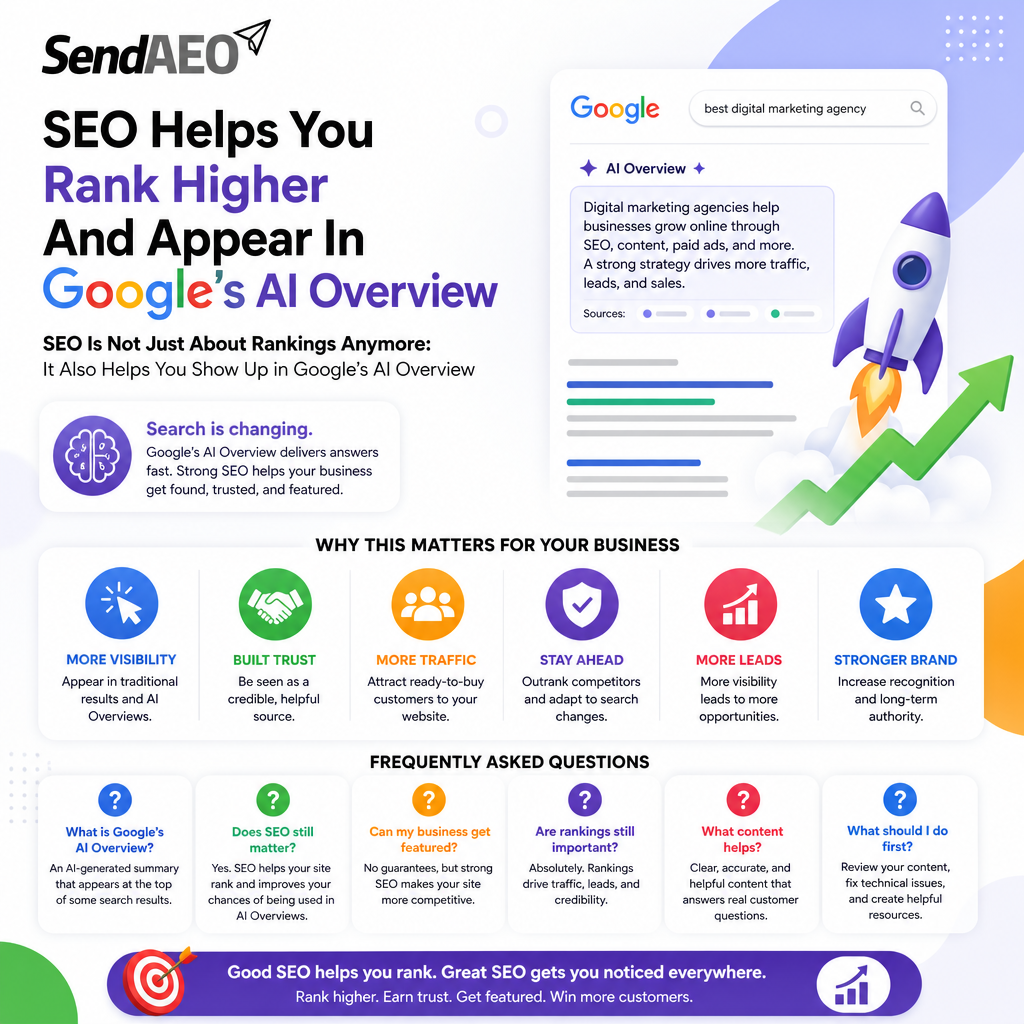
SEO Helps You Rank Higher And Appear In Googles AI Overview
SEO Is Not Just About Rankings Anymore: It Also Helps You Show Up in Google’s AI Overview
TL;DR: SEO is no longer only about getting your website to rank in the traditional search results. It is now one of the strongest ways to improve your chances of being mentioned, cited, or featured in Google’s AI Overview at the top of the page. Traditional rankings still matter because they drive clicks, visibility, and trust, but AI Overview visibility is becoming more important every day. From an SEO agency perspective, the goal today is bigger than “get to page one.” It is to make your business easy for Google to trust, understand, and surface in both standard search results and AI-generated answers. That means strong website content, technical SEO, authority, clear site structure, and content that directly answers real customer questions in plain language.
For years, business owners have heard the same version of SEO advice: rank higher in Google, get more traffic, and win more customers. That is still true. Rankings still matter. If your website does not appear prominently in search results, you miss opportunities to be discovered by people actively looking for your services.
But search is changing fast.
Today, when people search on Google, they increasingly see an AI Overview at the top of the results page. Instead of only showing a list of blue links, Google may generate a summarized answer that pulls together information from multiple sources. In many searches, that AI-generated response becomes the first thing users read.
That changes the conversation around SEO in a big way.
Now, SEO is not just about being found in search results. It is also about improving your chances of appearing in the AI-generated summary that sits above those results. If your business wants online visibility now and in the future, you need a strategy that supports both.
Why This Matters to Business Owners
From a client perspective, the key takeaway is simple: Google is changing how it presents information, and your business needs to adapt.
In the past, success often meant getting one of the top few organic rankings for an important keyword. Today, even if you rank well, users may first see Google’s AI Overview before they ever scroll to the standard results. That means the top of the search page is no longer reserved only for paid ads and the highest-ranking websites. AI-generated answers are now competing for attention too.
If your website content is well-structured, trustworthy, helpful, and relevant, it may help Google understand that your business is a valuable source for those summaries. In other words, good SEO does double duty: it helps you rank in the organic listings and improves your chances of being used as a source for AI Overview content.
For business owners, that creates a new kind of visibility opportunity.
What Is Google’s AI Overview in Plain English?
Let us keep this simple.
Google’s AI Overview is a search feature where Google uses artificial intelligence to create a quick summary answer at the top of some search results pages. Instead of forcing the user to click through several websites and compare information, Google attempts to give a direct overview right away.
That overview is usually based on information Google finds across the web. While the exact process is not fully transparent, one thing is clear: Google still needs reliable sources. It does not invent expertise out of nowhere. It looks for content it can understand, trust, and use.
That is where SEO comes in.
Search engine optimization helps make your site easier for Google to crawl, interpret, and evaluate. If your content clearly answers the right questions and your site demonstrates trust and expertise, you are giving Google more reasons to consider your pages as useful sources.
Traditional Rankings Still Matter a Lot
It is important not to overcorrect and assume that rankings no longer matter. They absolutely do.
Traditional organic rankings still matter for several reasons:
- They drive direct traffic. Many users still skip AI summaries and click standard organic results.
- They build trust. People often associate top-ranking businesses with authority and credibility.
- They support conversions. A well-ranked service page or product page can turn searchers into leads or customers.
- They increase brand visibility. Even if users do not click immediately, repeated exposure helps people remember your business.
- They influence AI visibility. Strong rankings often go hand in hand with the content quality and authority signals that can contribute to AI Overview inclusion.
So this is not an either-or situation. This is not “rankings versus AI Overview.” It is really about owning as much search visibility as possible.
A smart SEO strategy aims to help your business appear everywhere it can: in organic listings, in local search where relevant, and in AI-generated summaries where possible.
Why SEO Is One of the Best Paths Into AI Overview
Business owners sometimes hear “AI” and assume this is a completely separate discipline from SEO. In reality, SEO remains one of the most practical and effective ways to improve your visibility in AI-driven search experiences.
Why? Because Google’s AI systems still rely on content signals. They still need pages that are:
- Relevant to the search query
- Clear and easy to understand
- Helpful and specific
- Trustworthy
- Supported by a strong website experience
- Published by a business or source that appears credible
Those are all classic SEO concerns.
In other words, if your site is poorly organized, thin on content, slow, vague, outdated, or untrustworthy, it is harder for Google to treat you as a dependable source. On the other hand, if your website is technically sound and filled with useful, well-written, topic-focused content, you become much more competitive in both traditional search and AI-powered search experiences.
What Google Is Likely Looking For
Google does not publish a simple checklist that says, “Do these five things and you will appear in AI Overview.” If it were that easy, everyone would do it.
But based on how search has evolved, we can say with confidence that Google values certain qualities more than ever. From an SEO agency perspective, these are some of the most important:
1. Content That Clearly Answers Real Questions
If your audience is asking basic, practical, high-intent questions, your site should answer them clearly. Google wants to understand what your page is about and what problem it solves. Pages that wander, overcomplicate, or hide the answer behind fluff are less useful.
That is why content written in laymen’s terms often performs better than content that is overly technical or stuffed with industry jargon. If your customers ask, “How much does this cost?” “How long does it take?” “Do I need this service?” or “What is the difference between these options?” your website should answer those questions directly.
2. Demonstrated Expertise and Trust
Google wants confidence that the information it surfaces is accurate and helpful. That means your site should make it easy to see who you are, what you do, where you operate, and why your business should be trusted.
This includes strong service pages, a well-developed about page, consistent business information, signs of real experience, and content that reflects genuine knowledge instead of generic filler.
3. Strong On-Page SEO
On-page SEO still matters because it helps search engines understand your content. Proper headings, clear page topics, logical keyword targeting, descriptive titles, well-organized information, and internal linking all improve your chances of being understood correctly.
AI systems also benefit from content that is structured in a clear and predictable way. If your page is messy, scattered, or trying to target too many unrelated topics at once, that can work against you.
4. Technical SEO and Crawlability
Your content cannot help you if Google struggles to crawl or index it properly. Technical SEO is the foundation that supports everything else. Site speed, mobile usability, indexability, clean code, crawl efficiency, and organized site architecture all matter.
Think of technical SEO as making sure your website is easy for Google to access and interpret. If the technical foundation is weak, visibility in both rankings and AI surfaces becomes harder.
5. Authority Signals
Google has always looked for signs that a site is reputable. While no one outside Google knows the full formula, authority still matters. Brand mentions, quality backlinks, strong topical content, and overall web presence can all strengthen your position.
When your business consistently publishes helpful content and earns recognition across the web, that can reinforce the idea that your site is worth referencing.
The Shift From “Keyword Rankings” to “Search Presence”
One of the biggest mindset changes we encourage clients to make is this: stop thinking only in terms of single keyword rankings and start thinking in terms of total search presence.
Years ago, many SEO conversations focused heavily on where a website ranked for a short list of target keywords. That is still useful, but it is not the whole picture anymore.
Now the real question is:
How visible is your business across the entire search results experience?
That includes:
- Traditional organic rankings
- Local map visibility, if local SEO applies to your business
- Featured snippets and other SERP features
- AI Overview mentions or source visibility
- Branded search strength
- Coverage of informational, commercial, and transactional queries
When we talk to clients today, we do not frame SEO as a narrow rankings game. We frame it as a visibility strategy. The goal is to make your business impossible to overlook when your ideal customer searches.
What This Means for Your Website Content
If AI Overview visibility matters more every day, your content strategy needs to evolve with it.
Many business websites still have the bare minimum: a home page, a few service pages, a contact page, and maybe some old blog posts that do not address real customer needs. That was never ideal, and it is even less effective now.
To compete in today’s search environment, your website should do more than describe your business. It should actively educate potential customers and answer the questions they are already typing into Google.
That may include content such as:
- Detailed service pages that explain what you do, who it is for, and what to expect
- Location pages for the areas you serve, when appropriate
- FAQ content that addresses common concerns
- Articles that explain processes, costs, comparisons, timelines, and common mistakes
- Problem-solving content written around real customer search behavior
This type of content supports the customer journey at multiple stages. It can help someone just learning about the topic, someone comparing providers, or someone nearly ready to contact you.
It also creates more opportunities for Google to understand your expertise and potentially use your content in both traditional and AI-powered search features.
Laymen’s Version: How to Think About It
If you want the simplest possible explanation, here it is:
Google wants to give users the best answer fast.
If your website makes it easy for Google to see that you provide reliable, helpful answers, you are in a stronger position. That can help your site rank in normal search listings and can also improve your chances of being used in AI Overview.
So when we do SEO for clients today, we are not just trying to get your site “higher.” We are trying to make your business one of the best understood and most trusted answers in your space.
That is a bigger goal, and it is the right one.
What Businesses Should Do Right Now
If you are wondering what action steps make sense today, here is the practical answer from an SEO agency perspective.
Audit Your Current Content
Look at your site honestly. Does it answer the questions your customers actually ask? Is the content specific, useful, and current? Or is it thin, generic, and written mainly to fill space? Content quality has never mattered more.
Strengthen Your Core Service Pages
Your main money pages should be your strongest assets. They should clearly explain the service, the benefits, the process, common questions, and next steps. These pages often carry major SEO weight.
Build Helpful Supporting Content
Do not stop with sales pages. Supporting content helps Google connect your business to the broader topics and questions in your niche. It also gives users more reasons to trust you before they contact you.
Improve Technical SEO
Make sure your site loads well, works on mobile devices, is easy to crawl, and has a clear structure. Technical issues can quietly hold back everything else.
Focus on Topical Authority
Try to become a complete resource in your niche, not just a business with a brochure website. The more thoroughly and consistently you cover the important subtopics in your field, the stronger your search presence can become.
Write for Humans First, Search Engines Second
This matters even more in the AI era. Over-optimized, robotic, keyword-stuffed pages are not what users want, and they are not what Google wants to feature. Clear, natural, helpful writing wins.
Treat SEO as an Ongoing Strategy
Search is evolving too fast for one-time optimization to be enough. Your competitors are publishing, Google is changing, and user behavior shifts constantly. SEO is now an ongoing process of improving visibility across a changing search landscape.
Why an SEO Agency Approach Matters
From the outside, it can be tempting to think this is just about publishing a few blog posts or adding some keywords to a page. In reality, strong search visibility today usually requires coordination across multiple areas:
- Content strategy
- Keyword research
- Search intent matching
- Technical SEO
- Internal linking
- User experience
- Authority building
- Performance tracking
An SEO agency should be helping clients understand that modern SEO is not just about one ranking report each month. It is about building a digital presence that search engines and AI systems can confidently surface.
That means we are not only optimizing for where your website ranks. We are also optimizing for how your business is understood.
The Businesses That Will Win Going Forward
The businesses that succeed in the next phase of search will usually be the ones that do the basics exceptionally well.
Not gimmicks. Not shortcuts. Not mass-produced low-quality content.
The winners will be the businesses that:
- Publish genuinely helpful content
- Explain their services clearly
- Earn trust online
- Maintain technically strong websites
- Cover their topics thoroughly
- Align content with real customer questions
- Adapt as search behavior changes
That is encouraging news for good businesses. If you truly know your industry and care about serving customers well, SEO gives you a framework to turn that expertise into online visibility.
And now, that visibility can extend beyond traditional rankings into AI Overview as well.
Final Thoughts
SEO has always been about visibility, trust, and relevance. What has changed is the format of search itself.
Google is no longer just presenting a list of websites. It is increasingly presenting answers. That means businesses need to think beyond the old goal of “just rank higher” and focus on becoming a trusted source that Google can confidently surface in multiple ways.
Traditional rankings still matter and will continue to matter. They remain a major source of traffic and credibility. But every day, AI Overview visibility becomes a more important piece of the puzzle.
From our perspective as an SEO agency, the smartest strategy is not to choose between them. It is to build an SEO foundation strong enough to support both.
If your website is well-optimized, helpful, authoritative, and technically sound, you are not just improving your odds of ranking. You are improving your odds of showing up where search is headed next.
Frequently Asked Questions
What is Google’s AI Overview?
Google’s AI Overview is an AI-generated summary that can appear at the top of certain search results. It is designed to give users a quick answer by pulling together information from multiple web sources.
Does SEO still matter if Google shows AI answers first?
Yes. SEO matters more than ever. It still helps your website rank in traditional search results, and it also helps Google understand, trust, and potentially use your content in AI-generated overviews.
Can my business get featured in AI Overview?
No one can guarantee inclusion, but strong SEO improves your chances. Helpful content, topical authority, technical health, and clear answers to real search questions all make your site more competitive.
Are rankings still important?
Absolutely. Rankings still drive traffic, leads, and credibility. They are also part of the broader trust and visibility signals that can support performance in AI-driven search features.
What kind of content helps with AI Overview visibility?
Content that is clear, accurate, well-structured, and genuinely useful tends to help most. Pages that answer common customer questions in plain language are especially valuable.
Is AI Overview replacing traditional organic search?
Not completely. Traditional search results still matter a great deal, and users continue to click on them. AI Overview is an added layer of visibility, not a total replacement for organic rankings.
What should businesses do first?
Start by reviewing your website content, strengthening your service pages, fixing technical SEO issues, and creating useful content around the questions your customers already ask. That gives you a stronger foundation for both rankings and AI search visibility.
How long does it take for SEO to help with rankings or AI visibility?
SEO is a long-term strategy. Some improvements can make a difference relatively quickly, but meaningful gains usually take time and consistent work. The exact timeline depends on your market, competition, website condition, and content quality.