The Real Reason Dealers Lose Customers to Third Party Marketplaces
Why Dealers Lose Customers to Third-Party Marketplaces
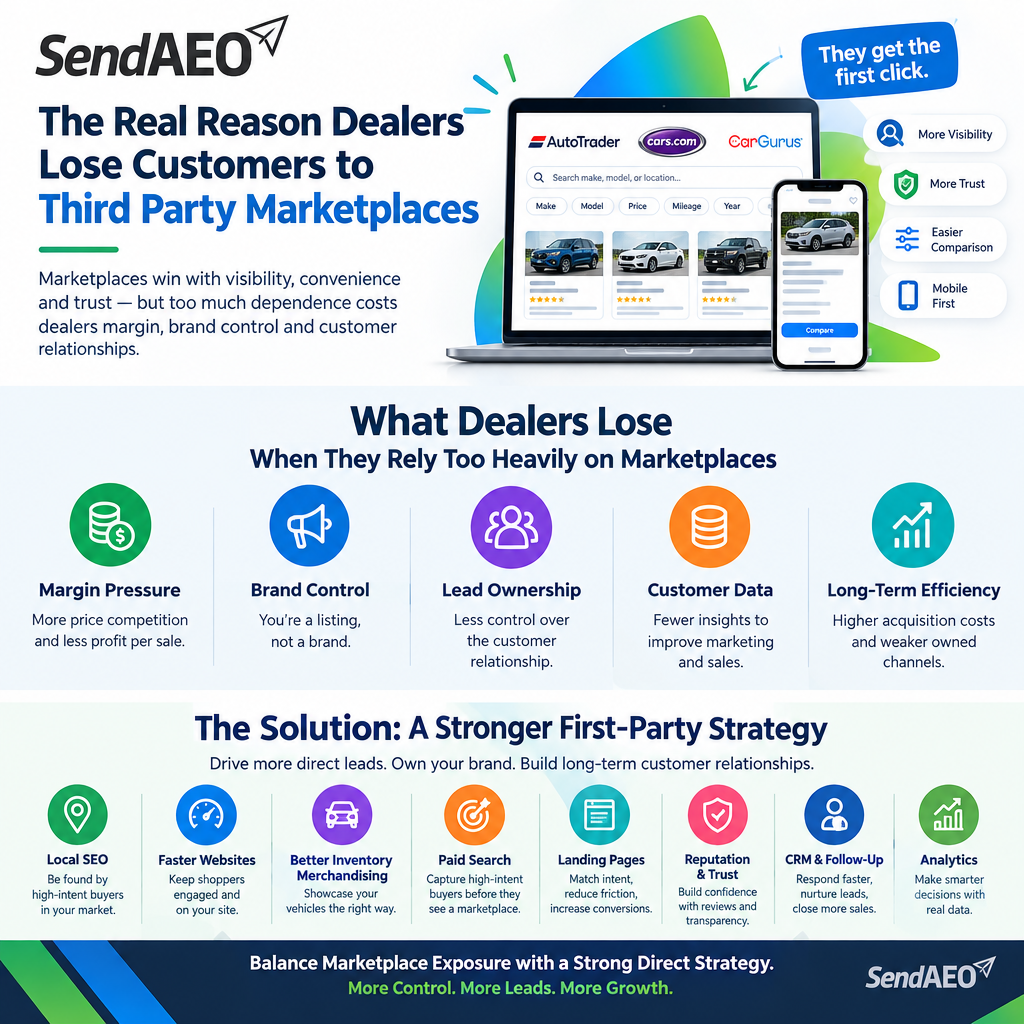
TL;DR: Dealers often lose customers to third-party marketplaces because those platforms dominate search visibility, simplify comparison shopping, build trust through convenience, and capture high-intent buyers before they ever reach a dealer’s website. When a dealership relies too heavily on listings instead of building its own digital presence, it gives away margin, brand control, lead ownership, and long-term customer relationships. The solution is a stronger first-party strategy: better local SEO, faster websites, stronger inventory merchandising, paid search campaigns, conversion-focused landing pages, reputation management, remarketing, CRM follow-up, and data-driven optimization that helps dealers generate more direct leads and reduce dependence on outside platforms.
Third-party marketplaces have become a major force in automotive shopping. For many buyers, these platforms are the first stop when comparing vehicles, prices, availability, and dealer reputation. They are easy to use, familiar, and built to keep shoppers engaged for as long as possible. While they can provide exposure, they can also quietly pull control away from the dealership.
That is the real challenge. Dealers do not just compete with other local stores anymore. They compete with large platforms that rank well in search engines, aggregate inventory at scale, shape buyer expectations, and often stand between the dealership and the customer. If that dynamic is not addressed strategically, a dealership can end up paying for visibility while losing direct traffic, brand recognition, profit margin, and long-term customer loyalty.
A better approach is not to abandon marketplaces entirely, but to reduce overdependence on them. Dealers need a digital strategy that strengthens direct customer acquisition, improves visibility in local search, increases website conversion rates, and creates a better online shopping experience than what most buyers expect from a dealership site. When that happens, third-party platforms become one channel among many rather than the channel controlling the relationship.
The Core Reason Dealers Lose Customers
The biggest reason dealers lose customers to third-party marketplaces is simple: marketplaces meet shoppers earlier in the buying journey and keep them longer. By the time a customer reaches an individual dealership website, they may have already compared multiple vehicles, reviewed pricing trends, read ratings, and formed an opinion about what dealer they trust most.
That early influence matters. When a marketplace controls the first interaction, the dealership often enters the conversation later and from a weaker position. Instead of introducing its value on its own terms, the store is forced to compete inside a comparison environment where price, payment estimates, and convenience are front and center.
This shifts customer behavior in several ways:
- Shoppers become less loyal to individual dealership brands.
- Vehicle listings are judged against dozens of similar options side by side.
- Price becomes the easiest comparison point, even when it should not be.
- The dealership loses control over how inventory, value, and service are presented.
- Lead ownership and customer data may be limited or diluted.
Once that pattern sets in, the dealership can find itself in a costly cycle: paying for third-party exposure, competing harder on price, and still struggling to convert enough direct opportunities.
How Third-Party Marketplaces Win Attention
Third-party marketplaces have invested heavily in the exact things many dealership websites underfund or postpone: search visibility, user experience, mobile performance, filtering tools, merchandising structure, and conversion optimization. This gives them a measurable advantage at the top of the funnel.
1. They Rank Well in Search Results
Marketplaces often dominate search engine results for high-intent phrases related to used cars, local inventory, pricing comparisons, vehicle research, and dealer reviews. When a buyer searches for a make, model, body style, or “cars for sale near me,” large listing platforms frequently appear before dealership websites.
That visibility is not accidental. These companies benefit from massive amounts of indexed inventory pages, strong domain authority, robust internal linking, structured data, and content ecosystems designed around search demand. As a result, the marketplace gets the click, and the dealer gets listed inside the marketplace rather than visited directly.
2. They Make Comparison Easy
Customers like efficiency. A marketplace lets a shopper compare multiple vehicles, stores, prices, mileage ranges, and features in one place. From the customer’s perspective, that is easier than opening several separate dealer websites with inconsistent layouts and search tools.
If a dealership website feels difficult to navigate, slow to load, or thin on useful information, the shopper naturally returns to the marketplace where the research process feels smoother.
3. They Build Trust Through Familiarity
Large platforms appear trustworthy because they are recognizable and standardized. Shoppers know what to expect. Listings often follow a predictable format. Filters work. Photos are easy to browse. Reviews are prominent. Value badges, pricing indicators, and comparison tools reduce friction and help people feel informed.
Meanwhile, many dealer websites still struggle with inconsistent inventory data, weak merchandising, limited transparency, and clunky lead forms. Even if the dealership offers an excellent in-store experience, the online first impression may not communicate that effectively.
4. They Capture Mobile Shoppers More Effectively
Most vehicle shoppers now begin on mobile devices. If a dealership site is slow, crowded, or difficult to use on a phone, buyers leave quickly. Third-party marketplaces are often optimized for mobile behavior, which means they can hold attention longer and move users further toward conversion.
What Dealers Really Lose When They Depend Too Much on Marketplaces
The immediate concern is usually lead volume, but the deeper losses are more significant. Overreliance on third-party marketplaces affects profitability, branding, operational efficiency, and long-term customer value.
Margin Pressure
When inventory is constantly displayed beside competitors in a price-driven environment, gross profit comes under pressure. Dealers feel compelled to lower prices or match marketplace expectations in order to stay visible and competitive. This can make every sale harder won and less profitable.
Brand Control
Marketplaces present the dealership as one option among many. That limits the ability to tell a stronger story about service quality, community reputation, financing support, trade-in expertise, warranties, delivery options, and ownership experience. The store becomes a listing rather than a brand.
Lead Ownership
Direct website leads are more valuable because they begin inside your ecosystem. You control the experience, the messaging, the calls to action, and the follow-up path. On third-party channels, the customer relationship may begin in a shared environment where attention is divided and loyalty is low.
Customer Data and Insight
Dealers who generate more direct traffic can learn more about shopper behavior. They can track which pages convert, which vehicles attract engagement, which campaigns drive quality leads, and where users drop off. That insight powers better decision-making. Heavy marketplace dependence often leaves fewer opportunities to build and use that first-party data effectively.
Long-Term Marketing Efficiency
Relying too heavily on paid third-party exposure can become expensive over time. If each lead must be bought repeatedly through outside platforms, cost per acquisition may rise without building a stronger owned channel. Investing in your own SEO, paid search, website conversion, email strategy, and remarketing creates assets that continue working over time.
Common Weaknesses That Push Customers Away From Dealer Websites
Many dealerships do not lose customers simply because marketplaces exist. They lose them because their own digital experience leaves room for a marketplace to outperform it. Some of the most common issues include:
- Slow website speed on desktop and mobile
- Poor local search visibility
- Thin inventory descriptions
- Low-quality or incomplete photos
- Confusing navigation and weak filtering tools
- Generic vehicle detail pages with little merchandising value
- Weak calls to action
- Long or frustrating forms
- Limited trust signals such as reviews, guarantees, or transparent pricing explanations
- Inconsistent follow-up after a lead is submitted
These are all fixable problems. In fact, they represent some of the biggest opportunities for dealers who want to reduce third-party dependency and capture more customers directly.
How to Reduce Dependence on Third-Party Marketplaces
The goal is not simply to “get more traffic.” The goal is to build a direct acquisition engine that attracts shoppers, keeps them engaged, and converts them into leads, appointments, and sales. That requires a coordinated strategy across SEO, paid media, website performance, inventory presentation, and lead handling.
Strengthen Local SEO
Local search is one of the most effective ways to win back visibility from third-party platforms. Buyers regularly search by geography, vehicle type, and urgency. A dealership that appears prominently in local results has a much better chance of capturing direct clicks before the marketplace does.
Strong local SEO includes:
- Optimized location pages
- Well-structured inventory pages
- Unique metadata and on-page content
- Accurate business information across the web
- Review generation and reputation growth
- Schema markup and technical SEO improvements
- Content built around local vehicle demand and search intent
When local SEO is managed well, the dealership begins to capture buyers who are ready to act in its market.
Improve Website Speed and Mobile Experience
Site performance has a direct impact on bounce rate, engagement, and conversion. If pages load slowly or core actions are hard to complete on mobile, shoppers leave before you have a chance to earn their trust.
Performance improvements often include image optimization, code cleanup, better page structure, cleaner navigation, and more intuitive mobile design. Faster websites keep users engaged longer and increase lead submission rates.
Upgrade Inventory Merchandising
Every vehicle detail page should work harder. Too many VDPs look nearly identical, offering only basic specifications and a form. Strong merchandising turns those pages into high-converting assets.
That means using:
- High-quality photos
- Compelling, unique descriptions
- Clear pricing presentation
- Payment and finance messaging
- Trade-in prompts
- Vehicle history highlights where appropriate
- Trust-building content such as service standards or reconditioning details
- Simple calls to action for questions, appointments, test drives, and reservations
Better inventory pages can significantly increase direct conversions and help compete with the convenience of marketplaces.
Use Paid Search to Capture High-Intent Buyers
SEO is essential, but paid search can accelerate visibility for valuable keywords and vehicle-specific demand. Strategic campaigns can target shoppers searching for exact makes, models, trims, financing terms, service-related dealership intent, and used inventory in your area.
Well-managed paid search helps dealers intercept buyers before they click into third-party environments. It also gives tighter control over messaging, offers, geographic targeting, and budget allocation.
Build Better Landing Pages
Sending traffic to generic pages wastes opportunity. Campaign-specific landing pages aligned with search intent convert better because they match what the shopper is looking for. Whether the focus is used trucks, certified inventory, bad-credit financing, trade-in opportunities, or a specific brand segment, each page should provide a clear path to action.
Landing pages should be focused, easy to scan, trust-oriented, and designed to reduce friction at the moment of decision.
Improve Lead Handling and Follow-Up
Even the best website cannot compensate for weak process after the lead comes in. Dealers often spend heavily to generate inquiries, then lose opportunities because of delayed responses, inconsistent communication, or generic outreach.
Better lead management includes faster response times, CRM automation, clear lead routing, appointment-setting workflows, personalized messaging, and ongoing reporting. When the entire funnel is managed well, direct marketing produces stronger returns and a better customer experience.
Use Remarketing to Stay in Front of Shoppers
Not every visitor converts on the first session. Remarketing keeps your dealership visible after someone visits inventory pages, financing pages, or trade-in tools. This helps re-engage serious shoppers who may otherwise return to a marketplace to continue comparing options.
With the right campaign structure, remarketing can support brand recall, inventory awareness, and lead recovery at a relatively efficient cost.
Strengthen Reputation and Trust Signals
Reviews, testimonials, transparent messaging, and clear service standards matter. A shopper comparing dealers online looks for reassurance that the dealership will be straightforward, responsive, and easy to work with. If those trust signals are weak or hard to find, a marketplace may feel safer by comparison.
Reputation strategy should include review generation, review response management, and better use of credibility indicators throughout the website.
How We Help Dealers Win More Customers Directly
Reducing third-party dependence requires more than isolated tactics. It requires a connected strategy built around visibility, conversion, and measurable growth. That is where focused support makes a meaningful difference.
We help dealers identify where customers are being lost, why those losses happen, and what changes will create the biggest impact first. The goal is to build a stronger direct pipeline so your store can compete more effectively without being forced to rely on outside platforms for every opportunity.
Digital Visibility Strategy
We improve how your dealership appears in search through local SEO, on-page optimization, technical improvements, and content aligned with buyer intent. This helps increase direct discovery and reduce the advantage third-party marketplaces often hold at the top of search results.
Website and Conversion Optimization
We evaluate the customer journey from homepage to inventory page to lead form. Then we improve the experience so more visitors stay longer, engage more deeply, and convert at a higher rate. This includes mobile usability, page structure, call-to-action placement, landing page strategy, and trust-building elements.
Inventory Marketing Support
Your inventory is one of your most important digital assets. We help position it more effectively through better merchandising, stronger page content, and search-friendly structures that allow vehicles and inventory categories to perform better organically and through paid campaigns.
Paid Media Management
We create and manage campaigns designed to attract high-intent shoppers before they get pulled into a marketplace-heavy path. From search campaigns to remarketing, the focus is on efficient spend, better lead quality, and continuous optimization.
Analytics and Performance Reporting
Dealers need clarity, not just activity. We provide reporting that connects traffic, lead sources, engagement, and conversion performance so decisions can be made with confidence. This makes it easier to see where budget should be shifted and which channels are producing the strongest returns.
Ongoing Strategic Guidance
The digital landscape changes quickly. Search behavior shifts, ad platforms evolve, and shopper expectations continue to rise. Ongoing support helps your dealership adapt, improve, and stay competitive rather than reacting after performance drops.
The Best Strategy Is Balance, Not Dependence
Third-party marketplaces can still play a role in a dealership’s marketing mix. They offer reach and can help move inventory. The problem begins when they become the foundation of customer acquisition rather than a supporting channel.
Dealers who perform best over time usually do not eliminate marketplace exposure. Instead, they balance it with a strong first-party digital strategy that builds direct traffic, stronger lead quality, better customer relationships, and more control over brand presentation.
That balance protects profit and creates resilience. If marketplace costs rise, rankings shift, or lead quality declines, the dealership still has owned channels producing results. That is the difference between renting attention and building an asset.
Final Thoughts
Dealers lose customers to third-party marketplaces because those platforms have made themselves indispensable to the modern shopper. They are visible, convenient, familiar, and designed to keep users comparing. But their strength does not mean dealerships must surrender the customer relationship.
With the right strategy, dealers can reclaim visibility, improve direct lead generation, strengthen conversion rates, and create a digital experience that competes more effectively at every stage of the buyer journey. That means investing in the channels and improvements that build long-term value: SEO, paid search, website performance, inventory merchandising, trust signals, CRM process, and analytics.
If your dealership is seeing strong marketplace activity but weak direct growth, the issue is not just traffic. It is control. The stores that win the most in the years ahead will be the ones that take more of that control back and turn their websites, campaigns, and customer experience into a true growth engine.
Frequently Asked Questions
Why do third-party marketplaces attract more shoppers than dealership websites?
They attract more shoppers because they are highly visible in search results, offer easy comparison tools, perform well on mobile devices, and create a familiar browsing experience. They simplify research, which is especially appealing to buyers early in the shopping process.
Should dealers stop using third-party marketplaces entirely?
Not necessarily. Third-party marketplaces can still be valuable for exposure and inventory movement. The real goal is to avoid becoming overly dependent on them by strengthening direct traffic and lead generation through your own website and marketing channels.
What is the biggest downside of relying too much on marketplaces?
The biggest downside is loss of control. Dealers often give up brand positioning, lead ownership, customer data, and margin. Over time, this can make customer acquisition more expensive and reduce long-term marketing efficiency.
How can local SEO help a dealership compete?
Local SEO helps a dealership appear in front of nearby high-intent shoppers searching for vehicles, financing, or dealership-specific services. Better rankings in local and organic results can increase direct website visits and reduce reliance on outside listing platforms.
What website improvements usually have the biggest impact?
The biggest gains often come from improving page speed, mobile usability, inventory merchandising, lead form design, calls to action, and trust signals. A better user experience helps keep shoppers engaged and improves conversion rates.
How do paid ads help reduce marketplace dependence?
Paid search campaigns can put your dealership in front of high-intent shoppers before they click a marketplace listing. With the right targeting and landing pages, paid media can generate more direct opportunities and support a stronger owned-channel strategy.
Can better follow-up really make a major difference?
Yes. Even strong traffic and lead generation can underperform if response times are slow or communication is inconsistent. Better follow-up through CRM workflows, automation, and personalized outreach can significantly improve appointment rates and sales outcomes.
How can we tell if our dealership is too dependent on third-party marketplaces?
Common signs include weak direct website traffic, a high percentage of leads coming from paid listing platforms, rising cost per lead, low branded search visibility, and limited control over customer acquisition performance. A channel audit can reveal where the greatest risks and opportunities exist.